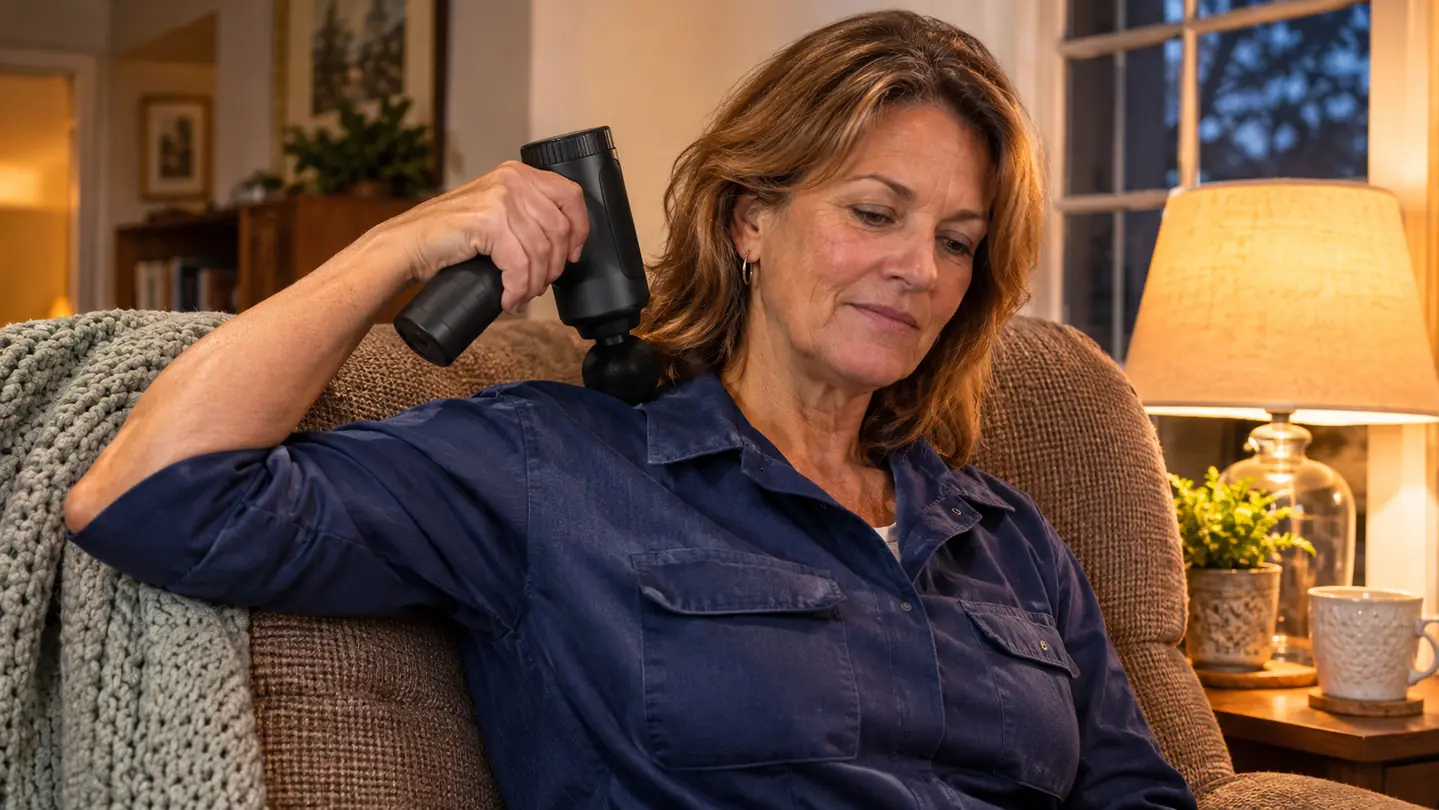
Twenty-six years of leaning over a dental chair does something to a right shoulder. Mine went from occasional stiffness to a knot that lived under the shoulder blade, the kind that makes you roll your arm while the coffee finishes brewing. I tried the free fixes first. A tennis ball pressed against a doorframe. Stretching videos I quit after a week. A heating pad that mostly made me sleepy. What I wanted was something I could use in the recliner at the end of a workday, without booking an appointment or driving across Greensboro in traffic.
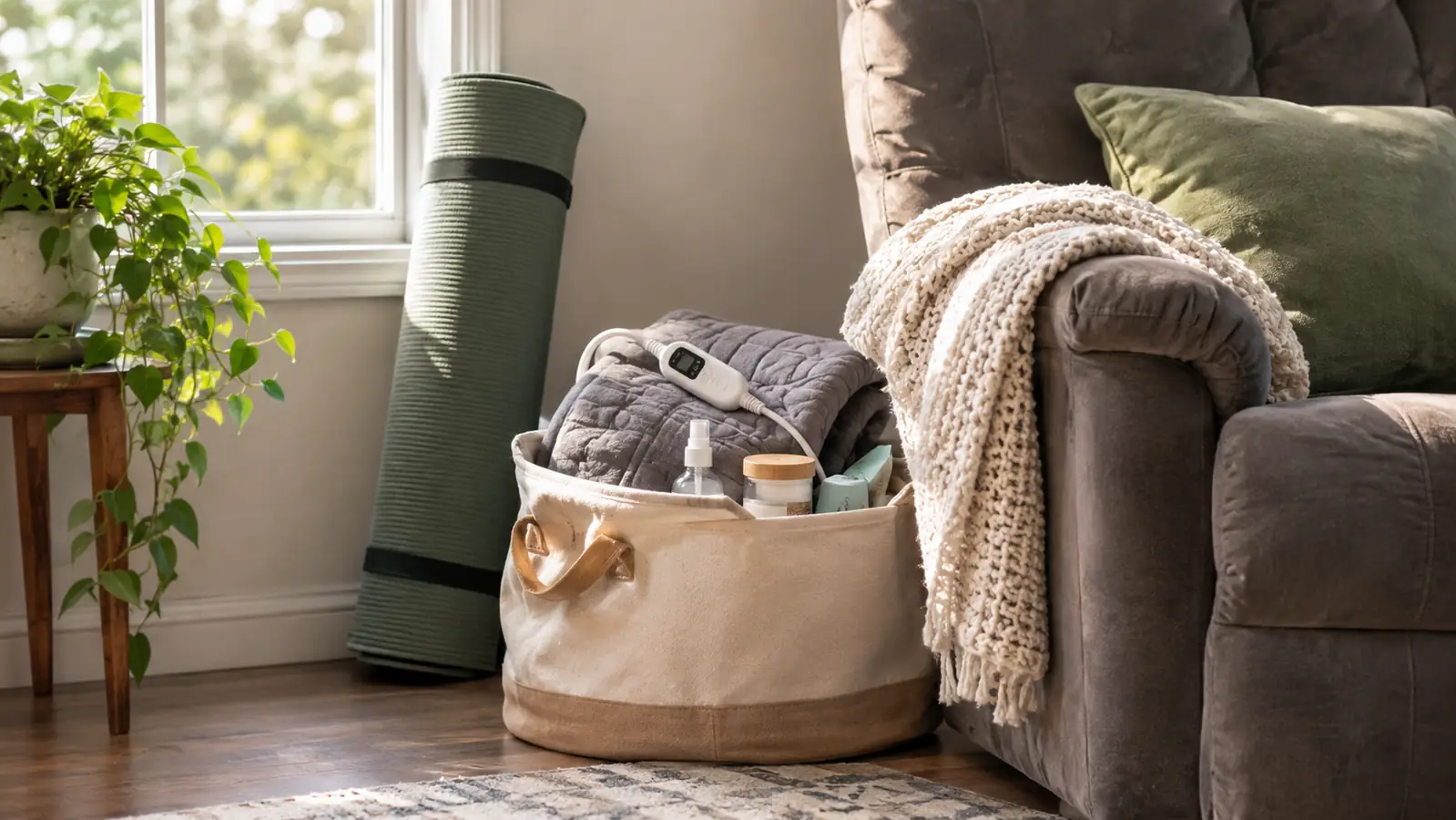
That is how the TOLOCO Massage Gun ended up in the canvas basket beside my recliner, next to the heating pad it partly replaced. I have used it most evenings for several months now, sitting in that chair and kneeling on a yoga mat on the bedroom floor. This is not a clinical review. I am a dental hygienist, not a physical therapist or a doctor, and I will say that again before the end. What follows is what the tool feels like in an ordinary evening, what I got wrong at first, and who I think should leave it on the shelf.
The Quick Verdict
Quiet enough to hear the evening news over, light enough to hold through a fifteen minute session, and the ten heads cover more ground than I expected. It does not replace hands-on work for a genuinely angry shoulder, and most people will use two of the ten heads and forget the rest.
Amazon Check Today's Price →The tool that ended up beside my recliner
Rechargeable, 2.1 pounds, and rated at 40 to 50 decibels, so the television stays on. Today's price is on the listing.
Amazon Check Today's Price on Amazon →How I've Used It
The routine is not complicated. I come home, change out of work clothes, and sit down with the gun in my lap while the local news runs. I work the upper back first, from the shoulder blade toward the neck, then the top of the right shoulder itself. Ten or fifteen minutes on a normal weeknight. On a day with a heavy patient schedule, the kind where I have been hunched over a smaller mouth for six hours, I take the full fifteen and I am not apologetic about it.
One evening in particular sticks with me. A Thursday in October, three back-to-back cleanings on a patient who could not open wide, and by four o'clock my right shoulder had that hot, deep ache that usually means two bad days coming. I sat in the recliner that night for the full fifteen minutes, broad head on the upper back, then the narrow one along the shoulder blade. By the time the weather came on, the ache had dropped to a dull note I could ignore. It came back the next afternoon, but smaller.
After my morning walk or a weekend in the garden, I take it down to the bedroom floor and use it on my calves, working up from the ankle, then the muscles to either side of my lower back. I stay off the spine itself. I also stay off the front of the neck and off anything bony, which is advice I got from my own doctor and would pass along to anyone reading this. If something is genuinely injured rather than merely tired, this is not the tool for it and you should ask a professional first.
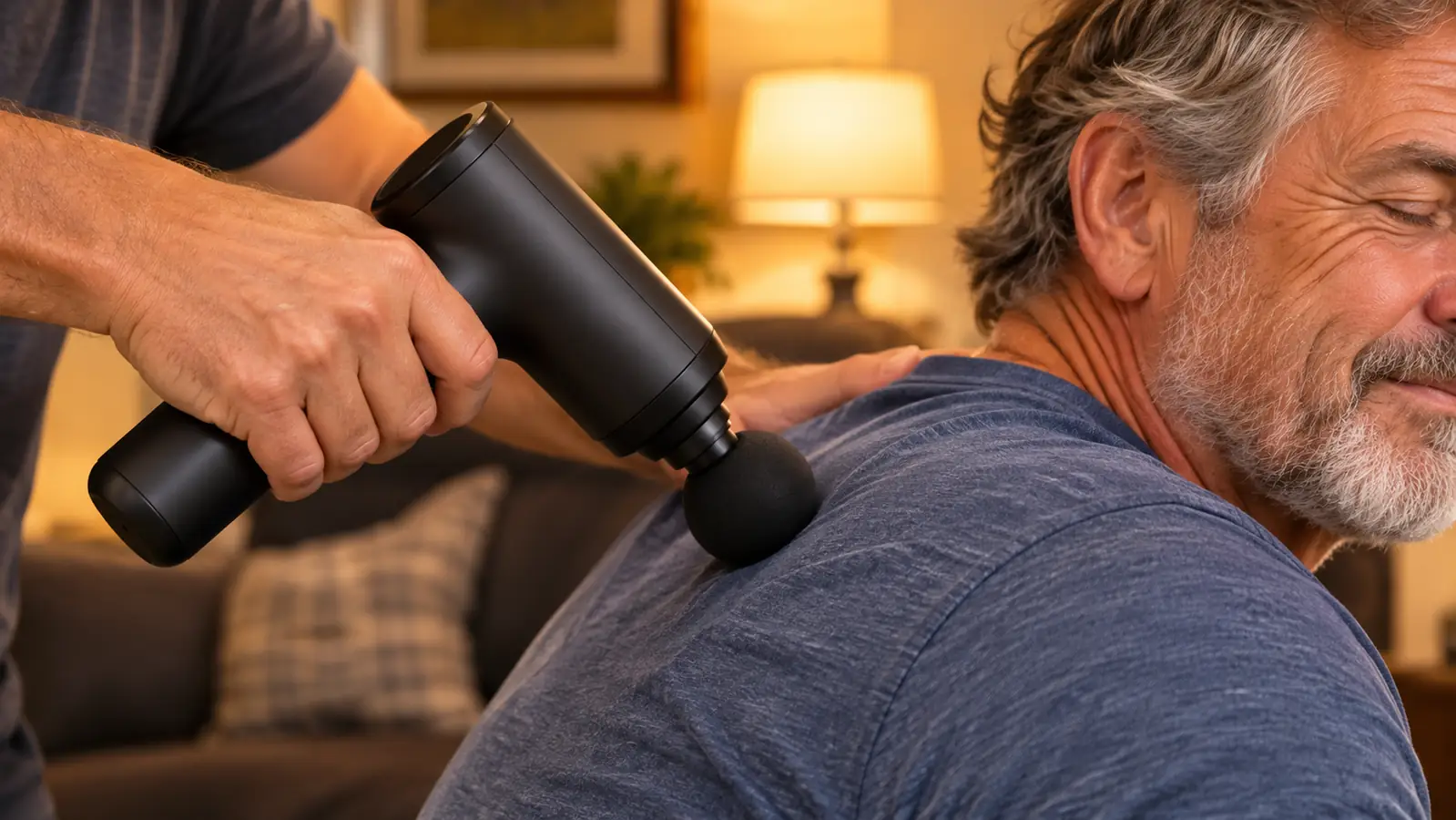
My husband Glenn borrows it most Sundays after golf. He is 58, retired, and plays like a man who believes his hips owe him something. He uses it on the top of each shoulder and around the hip, maybe five minutes a side, then hands it back without a word. Between the two of us it gets charged roughly twice a week with the USB cable that comes in the box. In several months it has never quit in the middle of a session, which is a low bar, but it is a bar a lot of small appliances fail.
What the Ten Heads Actually Change
Ten heads sounds like a marketing number until you are the one holding it. In practice I use two. A broad, rounded one for the upper back and shoulder, because it spreads the tapping over an area the size of a palm, and a narrower one for the strip of muscle that runs along the inside edge of the shoulder blade. That narrower head gets into the spot in a way a flat pad cannot.
The first week I tried a different head each night, which is the only sensible way to find out. I would put one on, work the shoulder for two minutes, and decide. By Friday I had a favorite and a backup. Glenn did the same on a Sunday afternoon and landed on a completely different pair. The choice turns out to be about the spot and the person, not about which head is best. What I did not expect is that it also depends on the day. The head that feels right after a light Tuesday is not the one I want after a Thursday like the one above, when the muscle is deeper and angrier and wants a gentler touch and more time.
The rest live in the basket. When Glenn has a specific complaint around the hip, he digs through them until he finds the shape he wants, uses it for four minutes, and puts it back in the wrong place. The honest summary is that ten heads means there is almost certainly a shape that suits the spot you are working on. It also means you will spend a week or two figuring out which one that is, and you will forget between sessions.
Everything arrives in one box: the gun, the ten heads, a USB cable, and a manual. Nothing else is needed. There is no app to install and no account to create, which for a 54-year-old who spends enough of her working day on a computer is a real relief. I read the manual on the second week, not the first, which brings me to the mistakes section further down.
How It Feels on a Tight Shoulder
The listing describes a 12mm amplitude and up to 3200 rpm, which means very little until you feel it. What it feels like is a fast, firm tapping that goes deeper than the surface. On the knot under my right shoulder blade, the first minute is not pleasant. It is the feeling of something pressing on a bruise. Then it eases, and by minute three the muscle has stopped arguing with me.
I time it now, roughly, by the minutes on the cable box. One minute on the knot, one minute circling the area around it, then a minute back on the knot. Three passes, then I move to the other side. In the second week I did not time anything. I stayed on one spot until it felt better, which it never quite did, because the muscle would ease and then tighten again the moment I stopped.
Where it does well: the upper back, the top of the shoulders, the calves, and the meaty part of the lower back. Where it does not: anything close to bone. The shoulder blade itself, the ridge of the hip, the shin. Percussion on bone is a sharp, unpleasant buzz and it accomplishes nothing. I learned that in the first week and I have not repeated it.
It also does not untie a knot permanently. I want to be clear about that, because plenty of reviews are not. What it does is shorten the time the muscle stays angry. A shoulder that used to nag me for three days after a hard week now usually settles by the next morning. That is not a cure. It is a smaller and more manageable problem, and for something I use in a chair while the news plays, it is enough.
A shoulder that used to nag me for three days after a hard week now usually settles by the next morning.
The Weight, the Noise, and the Charging Cable
The TOLOCO is 2.1 pounds and measures about 9.8 by 3.9 by 7.8 inches, which puts it in the range of a heavy hand tool. Held at chest height against an upper back, that is fine. Held overhead, or held out behind a shoulder at arm's length, two pounds starts to feel like five after a couple of minutes. I switch hands partway through. Glenn does not, and then complains that his forearm is tired, which is his own doing.
Two pounds does not sound like much in a listing. It becomes real the first time you try to reach behind your back at shoulder height, hunting the spot between the shoulder blades. I lasted about ninety seconds. Now I sit up straighter, bring the gun over the top of the shoulder instead of around, and let the weight rest against me rather than holding it out in the air. That one change made longer sessions possible.
The motor is rated at 40 to 50 decibels. In the living room with the television at a normal volume, I can hear the news over it. Glenn and I can hold a conversation without raising our voices. It is not silent, and in a quiet room on a hard floor you will hear it clearly, but it does not have the dentist-drill whine I was braced for.
Charging happens through the USB cable in the box. I plug it in when I think of it, usually on a weekend morning, and it has not run down in the middle of an evening. That is the whole of my experience with the battery. I do not track runtime and I would not trust a number from someone who did not measure it either.
What I Got Wrong at First
For the first two weeks I pressed. Hard. My reasoning was that a stubborn knot needed a firm hand, so I leaned the gun into the shoulder and let it work. The result was a bruised feeling the next day and a muscle that seemed tighter than before. Pressing harder does not go deeper. It just makes the surface sore, and then you cannot use the tool again for two days.
Mistake two was going straight for the sore spot and staying there. Ten minutes in one place on the worst knot left me tender for a full day. Now I start a few inches away, work toward the tight area, spend about a minute on it, and move on. Then I come back for a second pass. Circling rather than drilling. It takes a little longer and it does not leave me sore.
Mistake three was using it right before bed and expecting to fall asleep. On my calves, fine. On my upper back, it woke me up more than it settled me. I moved it earlier, to right after dinner, and that solved the problem. If you are the kind of person who cannot sleep after a late workout, try this earlier in the evening first and see how you feel.
Mistake four was skipping the manual. When I finally read it, the recommendations were close to what I had worked out by trial and error over two weeks. I could have read four pages and saved myself the soreness. If you buy one, read the four pages first.
What I Liked
- Quiet enough to use with the television on, rated at 40 to 50 decibels
- 2.1 pounds, light enough for a fifteen minute session if you switch hands
- Ten heads, so there is a shape for the upper back, the hip, and the calf
- Recharges over USB with the cable in the box and has never quit mid-session
Where It Falls Short
- Ten heads is more than most people will ever use, and the extras take up basket space
- Two pounds held overhead tires your forearm faster than you expect
- Very easy to overdo. Pressing hard leaves you sore the next day
- Percussion on bone is genuinely unpleasant and there is no way around that
Who This Is For
This is for the person who finishes a workday with a tight upper back and wants something they can use at home, in a chair, without an appointment. It suits people who are willing to use it for ten minutes most evenings rather than treating it as a one-time fix. It suits anyone whose soreness comes from posture and repetition, the leaning, lifting, standing kind, rather than from an injury. And it suits a household where two people will share it, because mine gets used by both of us most weeks.
If you walk or garden on weekends and your calves and lower back complain afterward, the TOLOCO earns its place for that alone. If you are a golfer with cranky hips and shoulders, you will find a use for it. If you simply want to stop rubbing your own shoulder against a doorframe every night, this replaces that ritual with something that takes less effort and works better.
Who Should Skip It
Skip it if the problem is an injury rather than muscle fatigue. A torn rotator cuff, a pinched nerve, a joint that is hot and swollen, a recent strain. Percussion is the wrong tool for those and could make things worse. Ask your doctor or a physical therapist what is appropriate, and do not take my word or any listing's word for it. I am a hygienist. I clean teeth for a living.
Skip it as well if you want deep, hands-on pressure. A percussion gun taps; it does not knead. Some people need the second thing and are disappointed by the first. Skip it if you dislike any noise at all, or if you know you will not hold something weighing two pounds above your shoulder for several minutes at a stretch. And skip the ten head version if you are the sort of person who will be annoyed by nine unused heads in a drawer. That is a fair reason to choose a simpler tool.
Ten minutes in the recliner, most evenings
2.1 pounds, rechargeable over USB, and quiet enough to keep the television on. Today's price is on the listing, along with the full head list.
Amazon Check Today's Price on Amazon →