Two tools, one pair of sore feet, and six weeks of using both on the same evenings. Here is the short answer. The Nekteck Foot Massager does the thing a massage gun cannot, which is work on both feet at the same time while you sit still and do nothing. A massage gun does the thing the Nekteck cannot, which is reach the calf, the quad and the spot beside your shoulder blade that has been complaining since your first year in hygiene school.
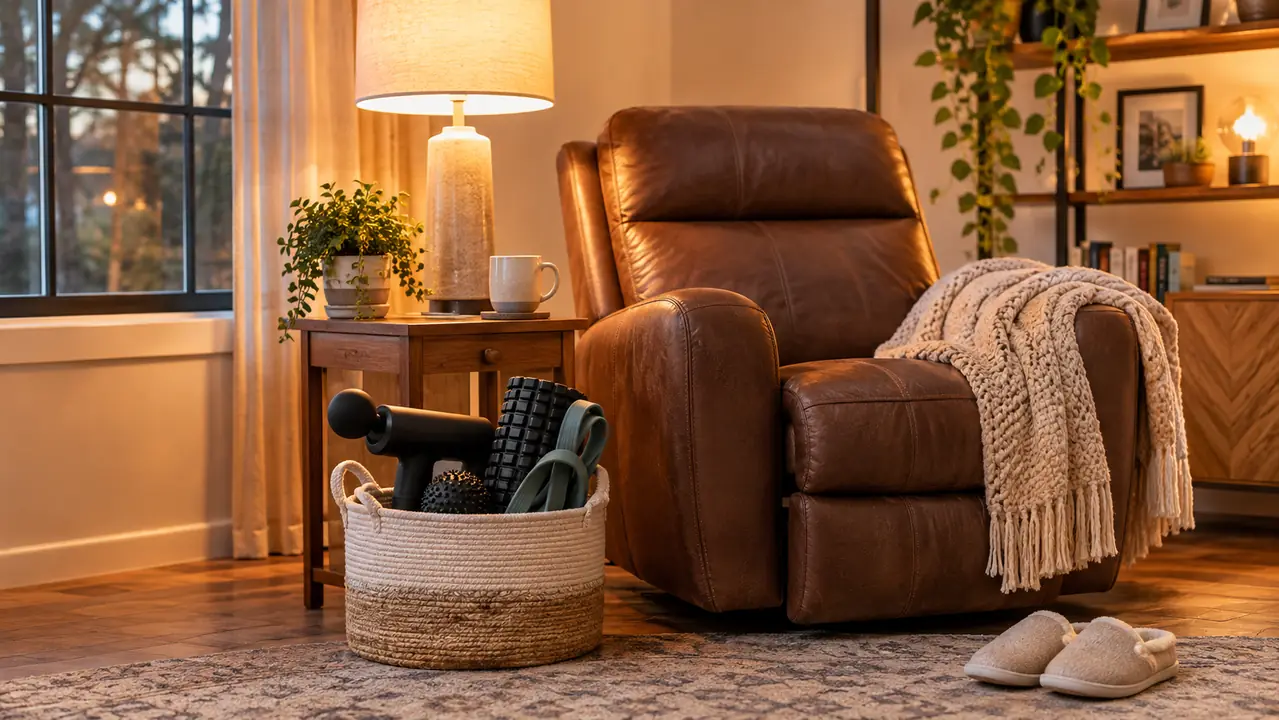
I am Delphine Marsh. I am 54, I have spent 26 years leaning over a dental chair, and I walk about three miles most mornings. My feet are not injured. They are tired by eight in the evening, the arches ache in a dull, unremarkable way, and the heels complain the day after I garden. So this is not a comparison written from a clinic. It is a comparison written from a recliner in Greensboro, with a canvas basket of recovery tools on the floor beside me and the television turned down low.
| Nekteck Foot Massager | Percussion massage gun | |
|---|---|---|
| Hands-free use | Sit down, both feet in, the machine does the work | Both hands on the tool, aiming it the whole time |
| Coverage of the sole and heel | Six massage heads with 54 rotating nodes work the whole foot | One head, moved around by hand |
| Heat | Heating function built in, switched on with a toe | No heat |
| Pressure control | Kneading pressure is fixed, so you press your feet down to change it | Lean in or ease off and the pressure changes in about a second |
| Reach above the ankle | Calf and leg are listed target areas, but you would sit and hold a foot against it | Calves, quads, hips and shoulders, anywhere you can point it |
| Moving around while you use it | Stationary and corded, tied to one outlet | Carry it room to room, use it standing up |
| Best for | Both feet at the end of a long day, hands free | One specific tight spot anywhere above the ankle |
Where the Nekteck Foot Massager Wins
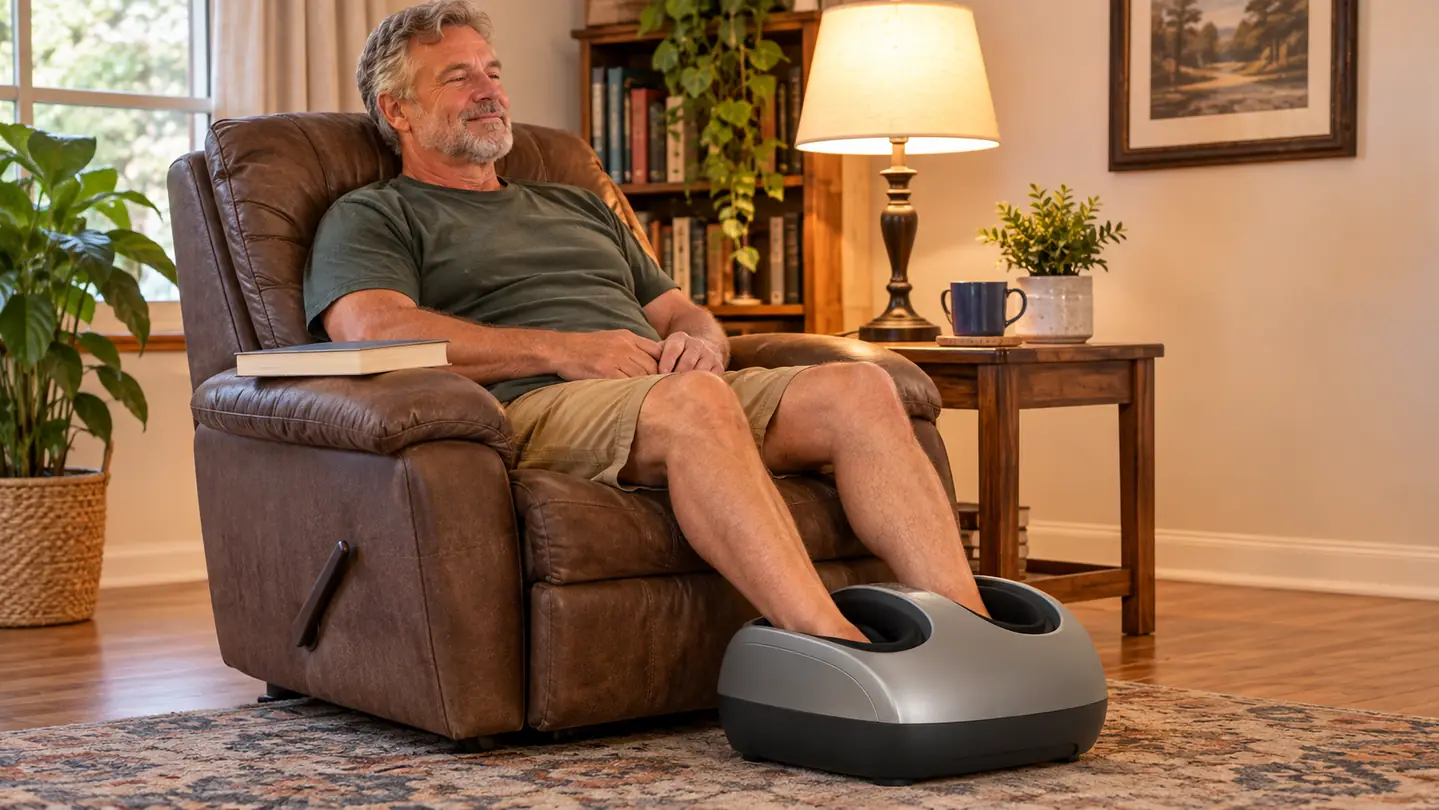
The Nekteck wins on the one thing that made me keep it plugged in, and it is worth being exact about it. You sit down, you put both feet inside, and the machine does the work. Six massage heads with 54 rotating nodes handle the kneading, and the unit reverses its direction as it runs, so the pressure does not travel in one predictable line over the same spot. Both feet are being worked at the same time. My hands stay in my lap. I have never had to aim it, hold it, or think about it once it is running.
Then there is the heat. The heating function is built into the same unit, and I switch it on with my toe, which sounds like a small detail until you have tried to lean forward and press a button while both feet are inside a machine. It has an auto shut-off, so the night I dozed off in the recliner I woke up to a unit that had already turned itself off. Nekteck lists it as quiet, and that holds, because I can hear the television over it. The trade-off is that it is corded, so it lives where the outlet is, which for me is the floor beside the recliner and nowhere else.
Where a Massage Gun Wins
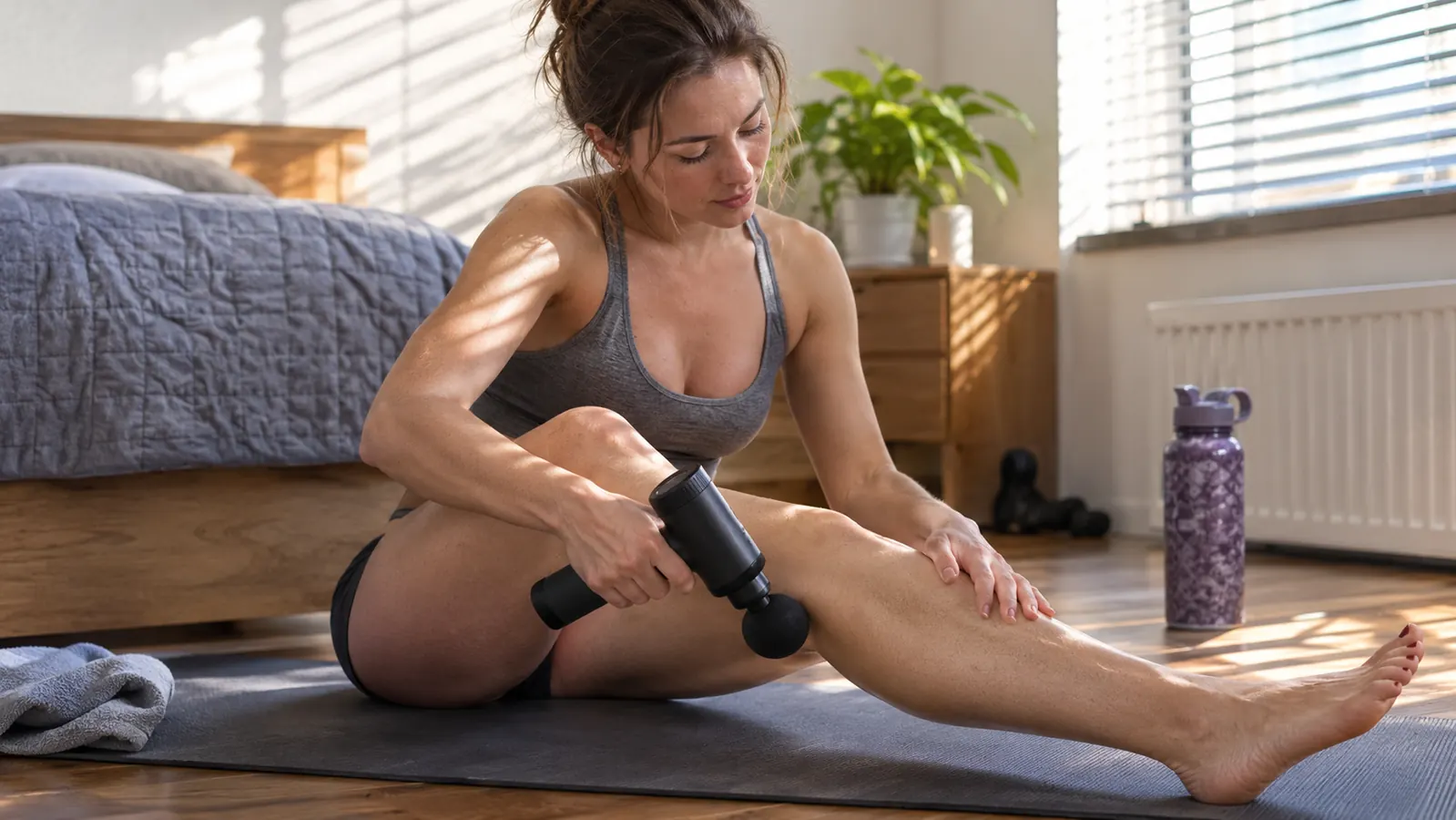
The gun wins on reach, and it is not close. Your foot is a broad, curved surface. Your calf is a rope, your quad is a slab, and the spot beside your shoulder blade is a knot you can only get at from an angle. Ten minutes on my calves after the morning walk does something the foot massager cannot do, because my calves do not fit inside it. Neither does Glenn's hip after a round of golf, which is the other reason the gun lives in the same basket.
Pressure control is the second win. With a percussion gun you lean in and the pressure rises, you ease off and it drops, and you get that feedback in about a second. With the Nekteck the kneading pressure is what it is, and the only adjustment is how hard you press your feet down into it. The gun is also the one that travels. It goes to the bedroom floor and the yoga mat, and it goes in the car on the weekends Glenn plays, while the foot massager stays where its cord reaches.
If your feet are the part that aches at eight in the evening, start here
Both feet at once, heat built in, hands free for fifteen minutes in the recliner.
Amazon Check Today's Price on Amazon →What Six Weeks of Evenings Actually Looked Like
The canvas basket beside the recliner holds the Nekteck, the percussion gun and a pair of wool socks I only wear in January. In the first week I used the foot massager every night and the gun not at all, which is what a new thing does. By the third week a pattern had settled. The massager came out after dinner, usually around eight, while Glenn watched whatever sport was in season. I ran it for fifteen to twenty minutes with the heat on and read on my phone, and that was the whole ritual.
The gun came out at different times. After the morning walk, if my calves were tight, for about two minutes on each side while I stood in the kitchen waiting for the kettle. After Glenn's Saturday round, when he would sit on the edge of the bed and work the gun into one hip and then hand it back to me looking relieved. It never once got used on my feet, because on my feet it felt like being poked efficiently. The Nekteck feels like being sat down and looked after, and those are not the same sensation, even when both of them leave the arches quieter. One Saturday in October sticks with me. Glenn had played eighteen holes in the cold and came in walking like a man ten years older, and I had spent the morning on my feet at the farmers market on brick for two hours. He took the gun to the bed and I took the recliner, and twenty minutes later neither of us was complaining about anything. That is the whole system now.
I also got the duration wrong at first. More felt better, so I ran it for thirty minutes and then thirty-five, and the next morning my arches felt buzzy and oversensitive in a way I did not enjoy. Fifteen to twenty minutes with the heat on is the point where my feet feel finished. Past that I am just sitting in a chair with my feet in a machine. That is a small thing to learn and it took me three weeks, so I am passing it along.
Fifteen minutes in the recliner with the heat on and both feet inside, and I stopped noticing my heels. That is the entire case for the Nekteck.
Why Feet Are a Different Job Than a Calf
A foot is not a small leg. It is a wide, arched platform with a lot of small bones packed close together, and the sole curves in two directions at once. Percussion is a point tool. It drives a head straight in, fast, at one spot, which is ideal for a belly of muscle like a calf. Kneading is a surface tool. It rolls and presses across a broader area, which is why the Nekteck, with six heads working at once, suits a shape like a foot better than a single pistol grip ever will. I also aimed the gun wrong the first several times. I put it on the ball of my foot, which felt busy and did nothing, because the place that ached was the outside edge of my arch, and the head slipped off that edge every time I shifted my weight. To reach it I had to turn the tool sideways and hold my foot at an angle with my other hand, and by then my wrist was tired and my foot had gone cold.
That is also why the two tools do not replace each other. When my arches ache after a long morning on my feet at the practice, the gun is useless to me, because I would have to hold it against the sole for ten minutes and my arm would give out before my foot did. When my calf is tight from three miles on the sidewalk, the Nekteck is useless, because I cannot fold my calf into it. They solve different shaped problems, and they both live in the same basket for exactly that reason.
What neither of them is, is a treatment. I am not a clinician and I am not going to pretend to be one. If the pain is sharp rather than dull, if it is worse in the morning and takes an hour to loosen, if there is numbness or tingling, or if one foot looks different from the other, that is a conversation with your doctor or a physical therapist. A gadget that feels good for fifteen minutes is not the same thing as care, and I would rather say that plainly than sell you something.
The Small Annoyances, Because Every Tool Has Them
The Nekteck is not water resistant, so mine stays out of the bathroom and I do not use it with damp feet or straight out of the shower. The housing is plastic, it weighs a bit under seven pounds, and it takes up roughly sixteen by fourteen inches of floor, which is fine beside a recliner and awkward in a small room. It is stationary, so you are not carrying it anywhere. The cord is what decides where it lives. The outlet nearest my recliner sits behind it, low to the baseboard, so the unit stays on the floor to the left of the chair and the cord runs under the edge of the rug. That works in a living room with space to spare and would be a nuisance in an apartment where the only free floor is the walkway to the kitchen. The gun's annoyances are the mirror image. It needs charging, it is loud enough that I cannot hear the television when I use it near my ears, and it demands that you hold it for the entire session.
The Question I Get Asked Most
The question from friends is always the same. If you could only keep one, which one. My answer depends on which complaint they lead with. If they describe their feet, I say the Nekteck. If they describe their back or their calves, I say the gun, and I say it without hesitating. If they describe both, which is most people past fifty, I tell them the truth, which is that I spent years buying the wrong tool for the wrong problem and the basket beside my chair is finally correct.
What I would not do is buy a percussion gun expecting it to solve tired feet. I tried that for a month before the Nekteck arrived, and what I learned is that a gun on the sole of a foot is a strange, ticklish, unsatisfying experience. The head is small, the arch is curved, and you end up bent over like a question mark trying to reach the outside edge of your own heel. I wanted it to work, mainly because the gun was already in the house and the massager was not, which is the worst reason to keep trying a tool. The rest of that month bought me nothing but a sore wrist. Fifteen minutes of that against fifteen minutes of sitting back with both feet in a warm machine is not a close contest. The Theragun-style tools are excellent at what they do. Feet are simply not what they do.
Who Should Buy Which
Buy the Nekteck if the soreness you are chasing is in your feet and you want it handled without effort. Buy it if you are the person who sits down at eight in the evening and would rather not take on one more physical task. Buy it if heat matters to you, if both feet need attention at once, or if you have a massage gun rattling around in a drawer because holding it felt like a chore. That last one is the most common story I hear from friends my age, and it is the reason I keep recommending this one.
Buy a massage gun if the tightness moves around, or if the target is calves and hips and shoulders rather than the sole of a foot. Buy it if you want one tool that drops into a bag and works on Glenn's hip after golf and on your own neck after a Thursday of hygiene appointments. If you can, buy both, because they are not competing for the same job and the basket by my recliner has room for two. If you can only have one, be honest about which body part is actually keeping you up.
The one that earned its spot beside the recliner
Six massage heads with 54 rotating nodes, heat built in, and an auto shut-off for the nights you doze off.
Amazon See the Nekteck Foot Massager on Amazon →