
By four o'clock most afternoons my right shoulder has climbed halfway to my ear. I have been a dental hygienist for 26 years, which means 26 years of leaning over a chair with my head tipped forward and my shoulders rolled in toward my chest. The tightness never announces itself. It accumulates quietly until I reach for something on the top pantry shelf and my neck refuses to turn the last few degrees. Stretching helps for an hour. A heating pad helps for ten minutes. What actually changed my evenings was a Mo Cuishle shiatsu neck and back massager draped over my shoulders while the local news played and I did absolutely nothing else.
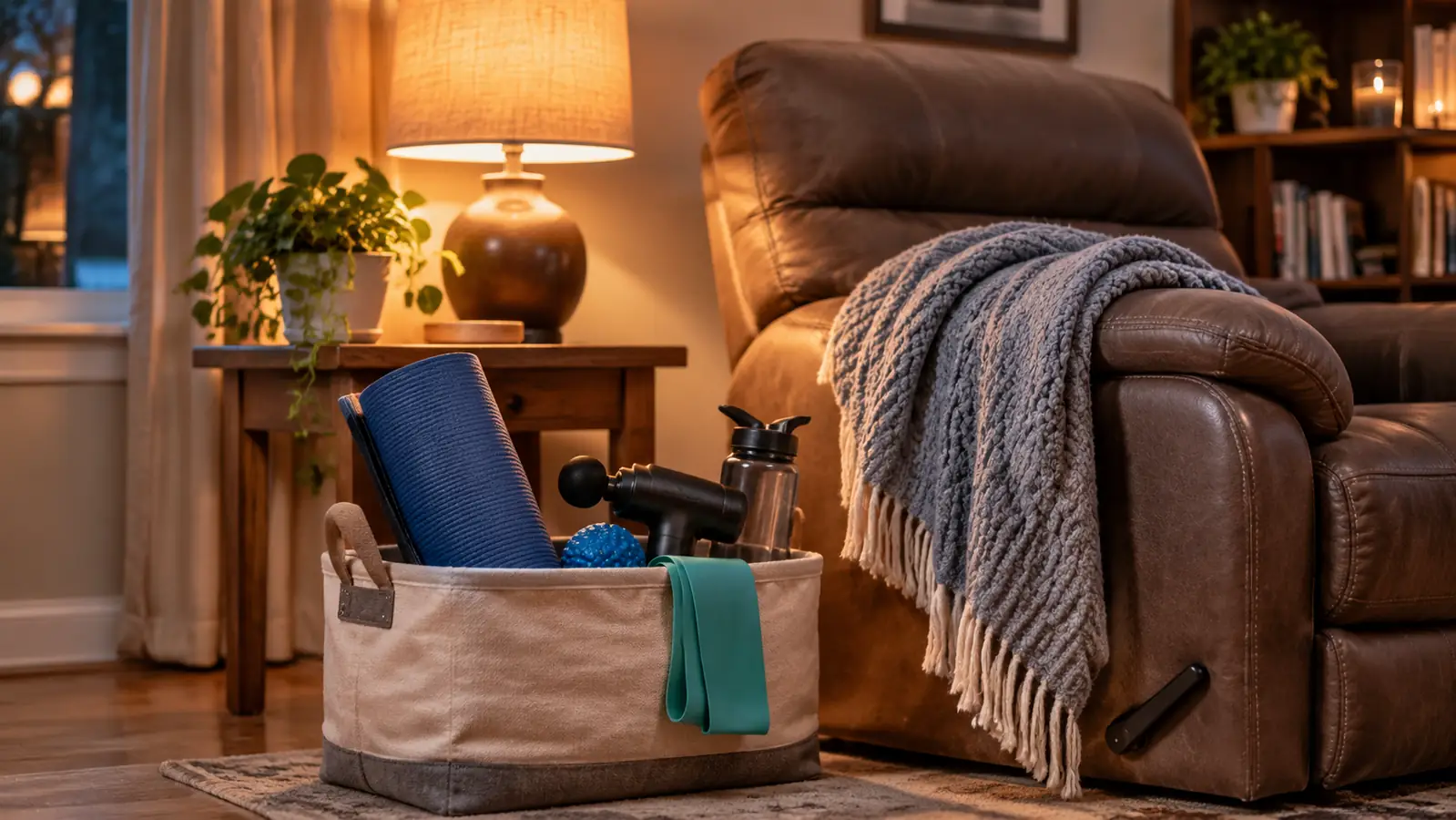
I am not a massage therapist and I am not going to pretend this is treatment. It is a tool that feels good on a sore neck at the end of a working day, and it has earned a permanent spot in the canvas basket beside my recliner. But I used it wrong for the first two weeks. I went straight to the fast speed, I left it running for half an hour, and I pressed it hard into the sore spots until I was tender the next morning. The routine below is what I settled into after that, and it is the one I still use four or five evenings a week.
The 12-Minute Reset I Do Most Evenings
16 kneading nodes, three speeds and gentle heat, corded so it stays exactly where you put it. Plug it in, sit back, and let it work.
Amazon Check Today's Price on Amazon →Five steps, about 15 minutes, and none of them require a mat on the floor unless you want one. I do this in the recliner with the cord running behind me to the outlet by the lamp. Glenn borrows the massager on Sunday nights after golf and does roughly the same thing on his shoulders, minus the neck portion, because he says the neck part makes him sleepy.
Step 1: Find the place your shoulders actually hold the tension
Most of us reach for the back of the neck because that is where the ache sits. But the ache is usually the end of the line, not the start of it. Before I switch anything on, I spend thirty seconds finding the actual spot. I roll my shoulders forward and back twice, tip my head ear to shoulder on each side, and notice where the pull stops me. For me it is the top of the right shoulder blade and the ridge that runs from my neck out to the shoulder. Almost always the right side, occasionally both after a long day of hygiene appointments.
I learned this the hard way on a Tuesday in March, after nine hygiene appointments and a grocery run. I had been rolling my upper back on a tennis ball pinned between me and the doorframe, which felt like progress for about four minutes and then made the whole area angry. What I was actually chasing was a spot at the top of the right shoulder blade, about two inches out from the spine. Once I found it with my fingers instead of rolling around blindly, the massager had something to aim at.
You are looking for a spot that feels like a knot rather than general soreness. Press gently with two fingers and see whether it sends a dull ache somewhere else. If it does, that is worth your time tonight. Say it out loud once if you are like me and forget. This matters because the massager is not clever. It kneads wherever you place it, and if you drape it somewhere random you will get a pleasant ten minutes and no real relief.
One caution here. If the tight spot is hot, swollen, or arrived after a fall or a sudden twist, stop. That is not a knot, it is a reason to call your doctor. I did that once, after a gardening afternoon that ended with me on the ground, and I am glad I did not try to knead it out myself.
Step 2: Set yourself up so your neck does not have to hold itself up
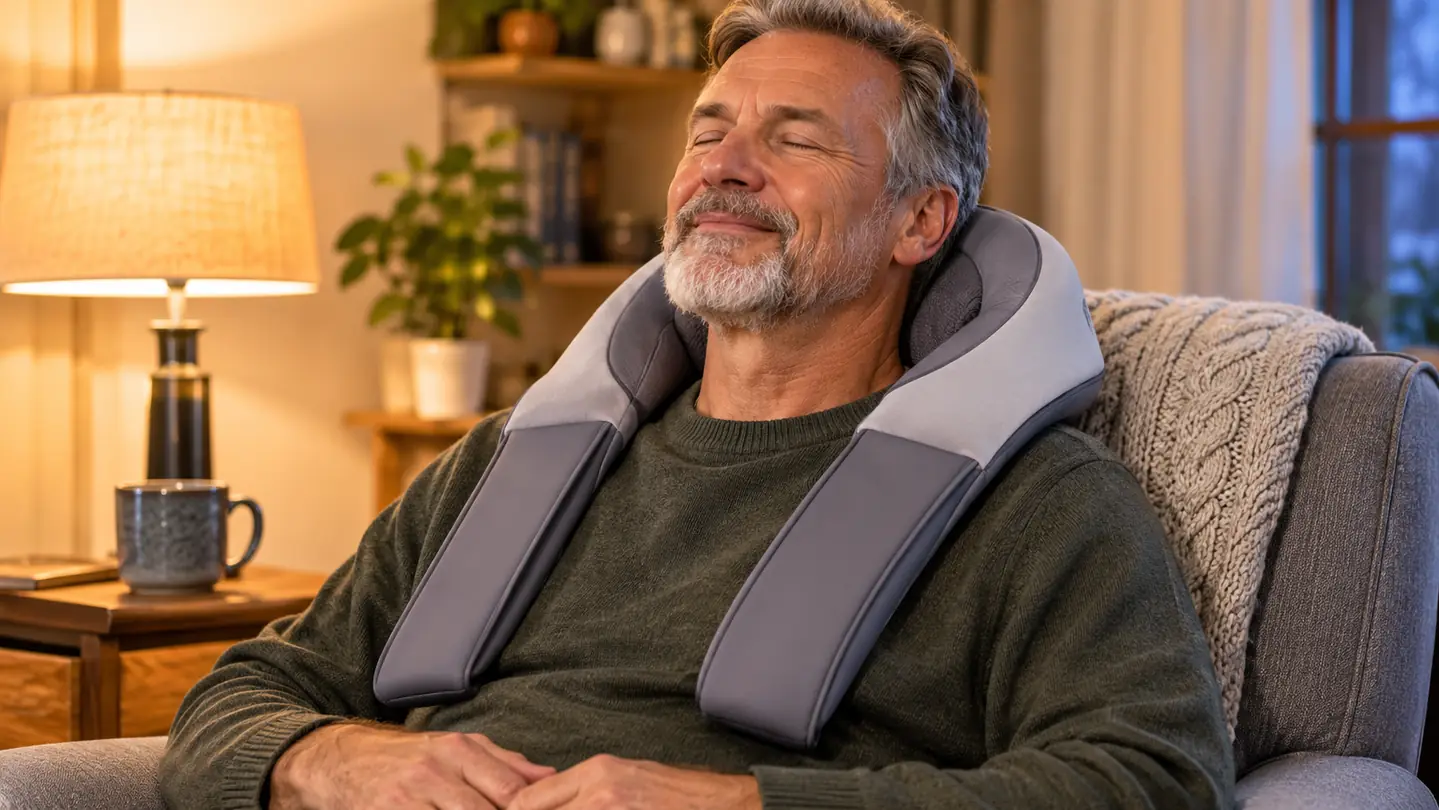
The single biggest mistake I made early on was using the massager while sitting upright at the kitchen table. The whole point is that the tool does the work while your shoulders drop. If you are holding your head up against gravity, your neck muscles are still contracting and you are fighting the massage the entire time.
My setup is the recliner with the back tipped one notch, feet up, a thin pillow behind my lower back, and the cord run behind the armrest so it does not drag across my chest. The Mo Cuishle is a wrap-around style, so it settles over both shoulders and the back of the neck. I let it sit where gravity puts it and I do not haul it down. That is the whole setup. It is corded, so I am tethered to the wall outlet, which honestly is a feature. It means I cannot wander off to fold laundry with it still on my neck.
If you prefer the floor, a yoga mat against the side of the bed works just as well. I do that maybe once a week when my lower back is also complaining, because the same tool on the mat covers my mid-back in a way the recliner does not. But for neck and shoulders alone, the recliner is where this lives.
Step 3: Start with heat and the slow speed, no exceptions
The massager has three speeds and a heat setting, and the temptation is to jump to the fast one because it feels like it is doing more. It is not. Fast is for when you have already loosened up and you want the sensation, not for the first minutes on a cold, tight shoulder. For the first four or five minutes I use the slow speed with the heat on and let the warmth do the opening work.
The first night I used it, I skipped all of this. I put it on fast with the heat off, because heat sounded like something for winter, and I sat there for 28 minutes because a timer had not occurred to me. I slept badly and woke up with a shoulder that felt bruised rather than loosened. Nothing was damaged. I simply overdid it, which is easy to do with something that feels pleasant while it is running. Now the heat goes on before I sit down and the speed stays slow until minute five.
My own rule now: slow for the first third, medium for the middle, and fast only if the muscle has already given up its grip. Which is usually minute ten, not minute two. If I start on fast, my shoulder tightens against the nodes defensively and I get less out of twenty minutes than I do out of twelve.
The heat matters more than I expected. It is gentle, not hot enough to be a heating pad, but it takes the edge off enough that the kneading does not feel like someone jabbing a thumb into a bruise. It is the combination, warmth plus the nodes, that makes this easier to sit through than a bare mechanical knead would be.
Twelve minutes, slow to medium, heat on. Twenty minutes on fast left me sorer the next morning than when I started.
Step 4: Let the nodes work, and change direction when you stop feeling it
The 16 kneading nodes work in opposing pairs, which is why the direction button matters. The default direction digs in one way, and after five or six minutes on a stubborn spot you stop registering it. Your nervous system tunes out constant input, that is just how it works. Pressing the direction button reverses the rotation and the same spot suddenly feels like new territory again.
I use that deliberately. Six minutes in one direction on the right shoulder, then reverse for another four. Then I lean slightly to the left so the nodes land a half inch over and catch the edge of the shoulder blade. Small shifts beat big ones. If you slide the massager around a lot, you spend more time repositioning than you do getting massaged.
Keep your hands off it. My instinct was to press the massager into my shoulder with both hands, which is exactly backwards. It weighs about 2.2 pounds and it does not need help. Pressing harder mostly compressed my own tissue against the nodes and left me tender. Let the weight of the wrap hold it in place and keep your hands in your lap.
Step 5: Stop before you feel finished, then move
This is the step I got wrong for two straight weeks. The end of a massage feels good, so the instinct is to keep going until the clock in your head says you have got your value out of it. The problem is that soreness from overuse shows up the next morning, not that night, so you have no feedback while you are doing it.
The clearest lesson came on a Saturday in late April after four hours of pulling weeds and edging beds. My lower back was complaining and my right shoulder was in its usual state, so I laid the wrap across my mid-back on the mat and let it run. I told myself I would stop at fifteen minutes and I did not. Forty minutes later I stood up stiff and stayed stiff through Sunday. Twelve minutes on Saturday and twelve on Sunday would have done more for me than the forty ever did.
My limit is 12 to 15 minutes total, and I stop while I still want a few more minutes. If a spot is truly stubborn I come back to it the next evening rather than grinding at it for 25 minutes. Two short sessions on consecutive days beat one long session every time I have tested it on myself.
Then move. Not a workout, just shoulder rolls, a slow head turn each way, and maybe a doorway stretch for the chest, 30 seconds per side. The muscle is warm and pliable right after the massager, and that is when a gentle stretch actually goes somewhere instead of pulling at a cold knot.
What Else Helps
The massager is one piece of a routine, not the routine. What has helped me most alongside it is boring: a pillow that actually supports my neck at night, a monitor stand so I am not craning down at a chart, and getting up between patients instead of staying hunched at the keyboard while I write notes. My neck tightness tracked my desk posture far more closely than it tracked anything else I changed, including the massager.
The pillow took two tries. The first one I bought was too tall and pushed my chin toward my chest, which is the opposite of what a stiff neck wants. The second was a contoured one about four inches high at the neck edge, and that was the difference. The monitor stand raised my screen so the top of the display sits at eye level, and I moved my keyboard back about three inches so my forearms rest flat instead of reaching.
Glenn has a different version of the same problem from golf, mostly the left shoulder and the hips, and he uses the Mo Cuishle on medium for about ten minutes after he plays. On his hips he lays the wrap across the front of the thigh with the nodes on the outer hip, which is not what the instructions suggest but works for him. He also does the thing I should do more of, which is a proper warm-up before he tees off rather than after.
If your neck is tight enough that it wakes you up, or you have numbness or tingling running down an arm, or the tightness has been building for months and keeps getting worse, that is beyond what a massager can address. I would see a doctor or a physical therapist before spending evenings on a tool, and I say that as someone who spent three weeks assuming it would pass on its own.
If your shoulders live up by your ears by 4 p.m., start with 12 minutes
The Mo Cuishle wraps over both shoulders with 16 kneading nodes, three speeds, a direction button and gentle heat. It runs on a cord, so it stays where you put it. 30-day money-back guarantee and a 1-year replacement policy.
Amazon Check Today's Price on Amazon →