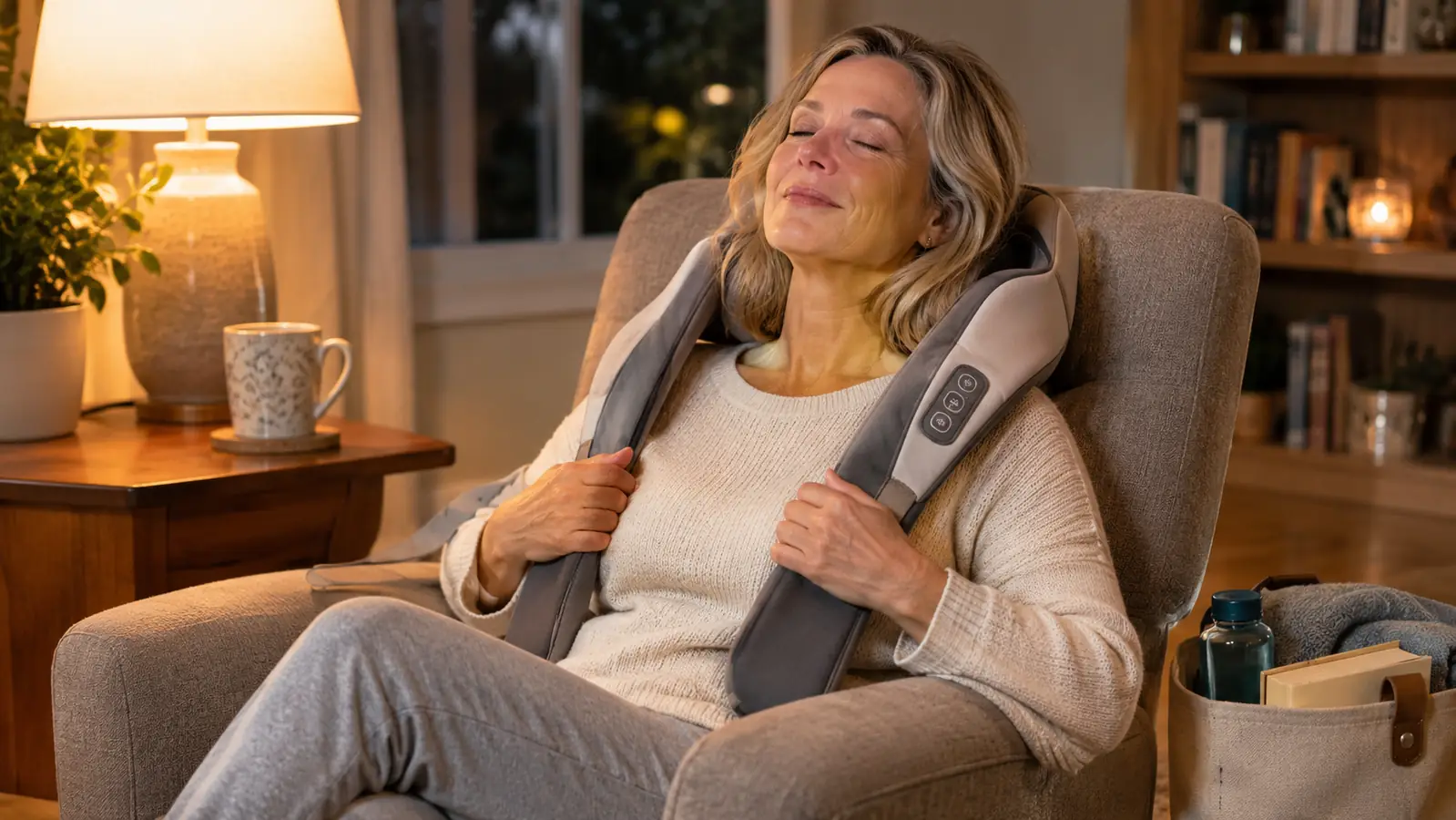
I bought the Mo Cuishle Shiatsu Neck and Back Massager on a Tuesday afternoon in a moment of pure self-pity. Twenty-six years of leaning over a dental chair had done what that does to a person's right shoulder, and my usual fix, a heating pad on the couch for twenty minutes, had quietly stopped being enough. Before we go any further: I am a dental hygienist. I am not a massage therapist, a physical therapist or a doctor, and nothing here is medical advice. What follows is one 54-year-old woman in Greensboro telling you what this thing feels like on a tired shoulder, what it does not do, and who should not buy it.
The short version: I still use it most evenings, roughly two months in, and I have complaints that would matter a great deal to some people and not at all to others. The Mo Cuishle massager is a corded wrap-around unit with sixteen kneading nodes, gentle heat, three speeds and a button that reverses the direction of the knead. It is not a deep tissue machine and it will not replace the woman who works on my shoulder once a month. It does one thing the heating pad never did, and the honest version of this review is mostly about why that is, plus the four or five places where it falls down.
The Quick Verdict
A genuinely useful corded kneader for neck and upper back tightness, provided you sit within reach of an outlet. The heat is mild, the nodes are firm, and it is not a substitute for a professional.
Amazon Check Today's Price →The tool that now lives beside my recliner
Sixteen kneading nodes, three speeds, gentle heat, and a direction button I use far more than I expected. Corded, so plan your seat before you order.
Amazon Check Today's Price on Amazon →How I've Used It
The massager lives in a canvas basket beside my recliner in the living room, next to the heating pad it partly replaced. Most nights I drape it over my shoulders while Glenn watches something with a lot of explosions, run it on the slow speed for about fifteen minutes, then press the direction button and go another five. I set a timer on my phone for the fifteen, because otherwise I would sit there until my neck went numb, which is exactly what I did in week one.
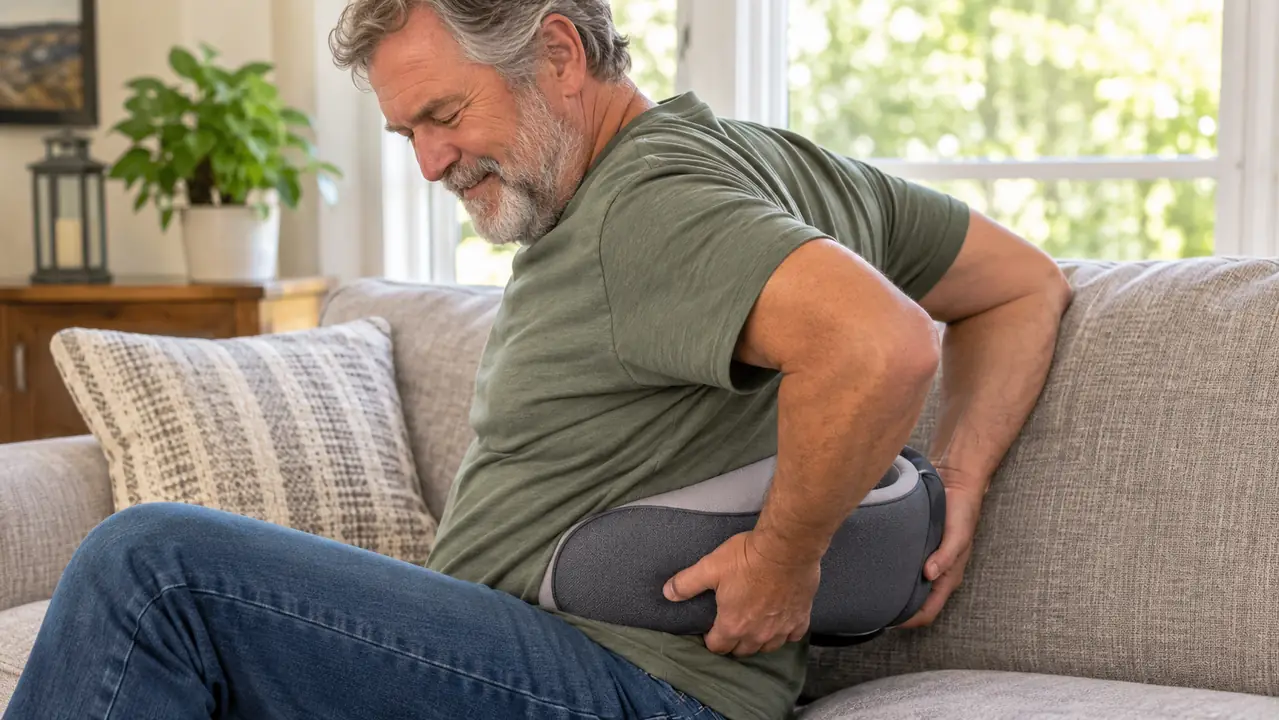
Glenn is 58, retired, and plays golf every weekend he can talk himself into. He borrows it for his shoulders on Sunday evenings, and he has started holding it against his hips after he stands up out of the chair, which is not what a wrap-around neck massager was designed for but works well enough if you keep both hands on it. He runs it on the fast speed. That tells you something about the two of us and something about the range of the three settings.
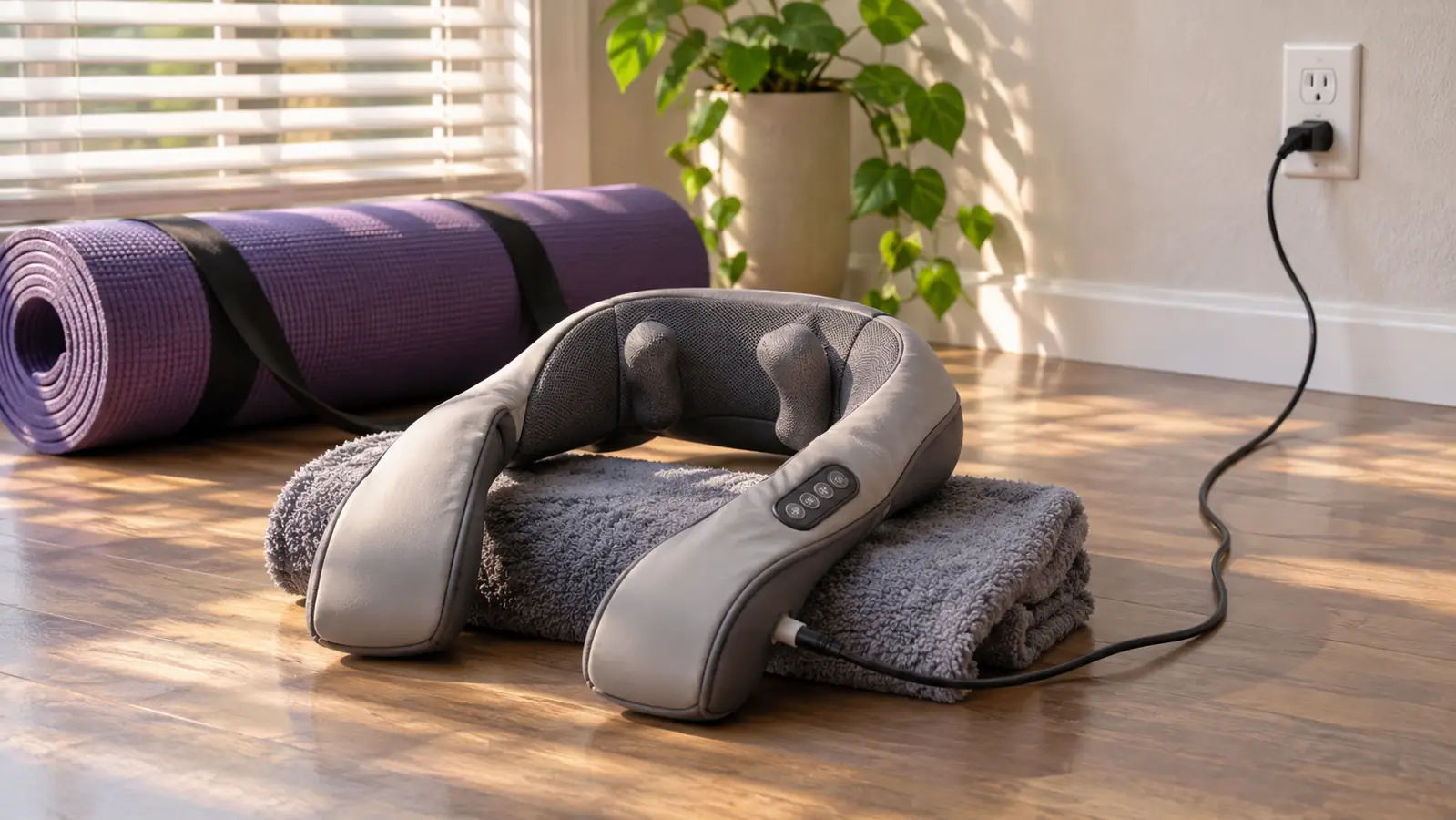
The third place it gets used is the bedroom floor. There is a yoga mat down on my side of the room, and I lie on my back with the wrap tucked under my lower back for ten minutes after a longer morning walk. It does for my lumbar area roughly what it does for my neck. My calves get it too, though that takes more holding and repositioning than I have patience for on most nights, and I usually give up and use the foam roller instead.
The routine did not arrive fully formed. It took about three weeks of fiddling to settle into what I actually do now, and the fiddling is worth describing because most reviews skip it. My first setup was the massager draped over the shoulder of my office chair while I answered emails at the kitchen table, and it was miserable: the wrap slid down my arm every time I reached for the keyboard, the cord ran across the middle of the floor where Glenn walks, and I spent more energy keeping it in place than I got back. The recliner works because it holds the wrap at an angle and my hands are free. If you are planning to use this at a desk, test the chair first.
What Nobody Tells You About the Heat
Every listing for a massager like this leads with heat, so let me be straight about it. The heat here is real, and it is gentle. It warms the surface. It does not do what my heating pad does, which is sink into the muscle and make me sleepy in front of the news. For the first week I kept waiting for the heat to arrive properly and it never quite did, and then I stopped waiting and started judging the thing on the kneading instead, which is where the Mo Cuishle actually earns its place in the basket.
The warmth does one specific job well, which is taking the edge off the first thirty seconds. Starting cold on a tight right shoulder is unpleasant, and that little bit of heat makes the first pass of the nodes tolerable. That is a smaller promise than the packaging makes and a more honest one. If what you want is deep penetrating warmth on a cold evening, this is not that product and I would rather say so now than have you find out in January.
Here is how I actually tested that difference, because I got tired of guessing. For eight nights in a row in February I used only the heating pad, twenty minutes, same chair, same time of evening, and wrote down on the back of a grocery receipt how my shoulder felt when I stood up and again the next morning. Then I did eight nights with the massager, heat on, same twenty minutes. The heating pad won the first ten minutes every single time. The massager won the next morning seven nights out of eight. I am not presenting that as research. It is one woman, a grocery receipt and a bad pen. But it told me what I needed to know about which tool does which job, and I stopped expecting one machine to be both.
The heating pad warmed the surface of my shoulder and made me sleepy. Fifteen minutes with this and I could turn my head to check my blind spot without the little wince.
Where it surprised me was the mornings after. I drive to the office on a road with a nasty merge, and the head check to the right has been a low-grade annoyance for two years. After a few weeks of evening use, that turn stopped costing me anything. Nothing dramatic. No cure. Just one small movement that stopped being a negotiation.
The Cord Decides Where You Sit
This is a corded machine. There is no battery, so the outlet determines where you use it, and that single fact shapes the whole ownership experience. In my living room it means the recliner, which is fine, because the recliner is where I was going to sit anyway. In the kitchen it means nothing, because the nearest outlet is behind the toaster and I am not rearranging my kitchen for a massager. If your favorite chair sits in the middle of a room with no outlet within reach, this will frustrate you every single evening, and no amount of good kneading will fix that.
I solved it by moving a short extension cord into the basket, which is a small thing, and it is still a thing I had to do. The cord is the length you would expect for a device built to sit on a couch, and it gets in the way when you shift position. Twice I have pulled the plug out of the wall by leaning too far forward. That is my fault and it was also completely predictable, and it is worth knowing before you buy.
Sixteen Nodes, Three Speeds, One Direction Button
The sixteen kneading nodes are the whole story. They rotate in pairs and press in a way that feels closer to a pair of thumbs than to the buzzing you get from the cheap units sold at the pharmacy counter. The three speeds are genuinely different from each other. Slow is slow enough to relax into. Medium is my default and probably yours. Fast is for Glenn, and for anyone who wants to feel something happening rather than settle into it.
The direction button is the part I did not expect to use daily. Reversing the knead halfway through changes which part of the muscle gets worked and, more usefully, stops the same spot from going sore under the same pressure. On my right shoulder I run one direction for seven or eight minutes, then reverse for the rest, and the difference in how the area feels the next morning is noticeable enough that I stopped skipping it.
What you cannot do is change the spacing of the nodes or their firmness. They are where they are and they press how they press. For me that lands right on the neck and the upper back and slightly wrong on the shoulder blade, where the bone sits close to the surface. A folded hand towel between me and the leather surface softens it enough to keep going. That is the entire adjustment mechanism in this house, and it works well enough that I have not thought about it since March.
What I Got Wrong at First
Week one, I overdid it. I used it for forty minutes the first night because it felt good, and I have never met a good thing I could not ruin by doing too much of it. The next day my neck was tender in a way that had nothing to do with the original tightness, and I spent a day annoyed at a device that had done exactly what I asked. Fifteen minutes is the number I landed on. If I were starting over I would begin at ten.
I also started on the fast speed, because on slow it felt like nothing was happening. That was the wrong instinct. Slow, for the first few minutes, is what lets the muscle stop bracing against the pressure. Now I do slow, then medium, and I only touch fast when the knot is already mostly gone and I want to finish the job.
One more mistake worth confessing, because I suspect it is common. I wore it over a thick turtleneck for the first two weeks of cold weather and could not work out why the nodes felt muffled and useless compared with the week before. Glenn pointed out the obvious. Against a thin cotton shirt the kneading is what it is meant to be. Through a sweater you are mostly massaging the sweater. If you buy this in December and it feels weak, take off a layer before you write a complaint.
Two Months In: What Changed
The honest answer is that nothing dramatic changed, and that is the point. My shoulder is not cured. I still have a tight upper back at the end of a six-patient morning, and I still see the woman who works on me once a month. What changed is the hour before bed. The heating pad used to make the tightness feel better for ten minutes after I stood up. The Mo Cuishle makes it feel better for most of the evening, and I sleep through the night more often than I did in the spring.
The leather has held up. The nodes have not loosened and the wrap has not lost its shape, which I half expected given how often Glenn yanks it off the back of the chair. It is a 2.2 pound object that gets moved five times a day in this house, and it looks like it did in week one, which is more than I can say for the heating pad cover. At 12 by 4.3 by 7.28 inches it fits behind the recliner cushion without sticking out, which matters more than I expected in a room where everything else is already crowded. I have not had a single problem with the cord or the plug in eight weeks of daily use, and that is the kind of thing that usually fails first.
The Little Things That Annoy Me
Changing a setting means reaching for the unit itself rather than a remote, so once it is settled on your shoulders the buttons are a small reach away. That is fine for speed and direction. It is less fine when you are comfortable and want the heat on, because it means breaking the position you just found. Not a deal breaker. Just a thing I have noticed forty times.
The wrap also slides when I lean back too far in the recliner, and if I stand up wearing it, the weight pulls it forward off my neck. It is not a device you forget you are wearing. Some people will like that, because it keeps you in one place for fifteen minutes, which is arguably the hard part of recovery anyway. Some people will find it fussy. Both reactions are reasonable.
Last complaint, and it is the one I would fix first: the gentle heat and the firm knead do not quite agree with each other. When the nodes are working a knot, I want more warmth than it gives. When the warmth is doing its thing, I want the nodes to back off. You cannot dial those independently, so you pick a speed and take the heat as it comes. It is a small mismatch and it is the reason I keep the heating pad in the basket instead of putting it in the closet.
What I Liked
- Sixteen kneading nodes that knead rather than buzz, closer to thumbs than to vibration
- Three speeds that are actually distinct, with a slow setting gentle enough to relax into
- A direction button that reverses the knead, which matters on the second half of a session
- Useful on lower back and calves, not only on the neck
- Gentle heat that takes the edge off the first minute without ever feeling hot
- Thirty-day money back and a one-year replacement policy
Where It Falls Short
- Corded only, so you are tied to an outlet and probably to one chair
- The heat is mild and will not replace a heating pad for deep warmth
- The nodes are firm enough to be too much on a bony shoulder at first
- At 2.2 pounds it slides off if you stand up wearing it
- No way to adjust the spacing of the nodes or their pressure
- Cannot set the heat and the kneading independently
Who This Is For
This is for the person who sits or leans for a living and has a neck and upper back that complain at the end of the day. If you are within reach of an outlet, if you want firm kneading rather than vibration, and if you accept that fifteen minutes is the useful dose, the Mo Cuishle will earn its spot beside your chair the way it earned its spot beside mine. It is also a reasonable first step if you have been wondering whether kneading helps you at all before you commit to a monthly appointment with a professional.
Who Should Skip It
Skip it if you want deep heat, because the heat is gentle and it is not a heating pad. Skip it if your chair is nowhere near an outlet and you are not willing to run an extension cord across the rug. Skip it if you need something you can walk around with or fold into a suitcase. And skip it, please, if anything in your neck or shoulder is injured, undiagnosed or getting worse. Ask your doctor before you put a kneading device on something that is already angry. If the pain runs down your arm or your hand goes numb, that is a conversation for a clinician, not for a massager and not for me. I am a dental hygienist. I know teeth.
If your neck is the thing that ends your day, start here
Sixteen nodes, three speeds, a direction button worth using, and gentle heat that takes the edge off. Thirty-day money back and a one-year replacement if it turns out not to be for you.
Amazon Check Today's Price on Amazon →