My upper back has been tight since roughly my fifteenth year of leaning over a dental chair, and I have tried almost everything to loosen it. Stretching holds for about twenty minutes. Heat holds for about ten. What has actually changed my evenings is a short appointment on the bedroom floor with a TriggerPoint GRID foam roller, and it took me a full year to learn how to do it without making the tightness worse. This is that routine, written the way I would explain it to a coworker at the end of a long Thursday.
I am a dental hygienist in Greensboro, North Carolina, and I am 54. I am not a physical therapist and I am not a doctor. What I can tell you is what a roller feels like under a sore back, how long I actually stay on it, and which mistakes cost me weeks. The first one is the big one: rolling fast. The second is rolling the wrong part of the back. The third is treating it like a workout you have to push through. None of those are necessary, and all three are easy to fix.
The 13-inch roller that lives by my recliner
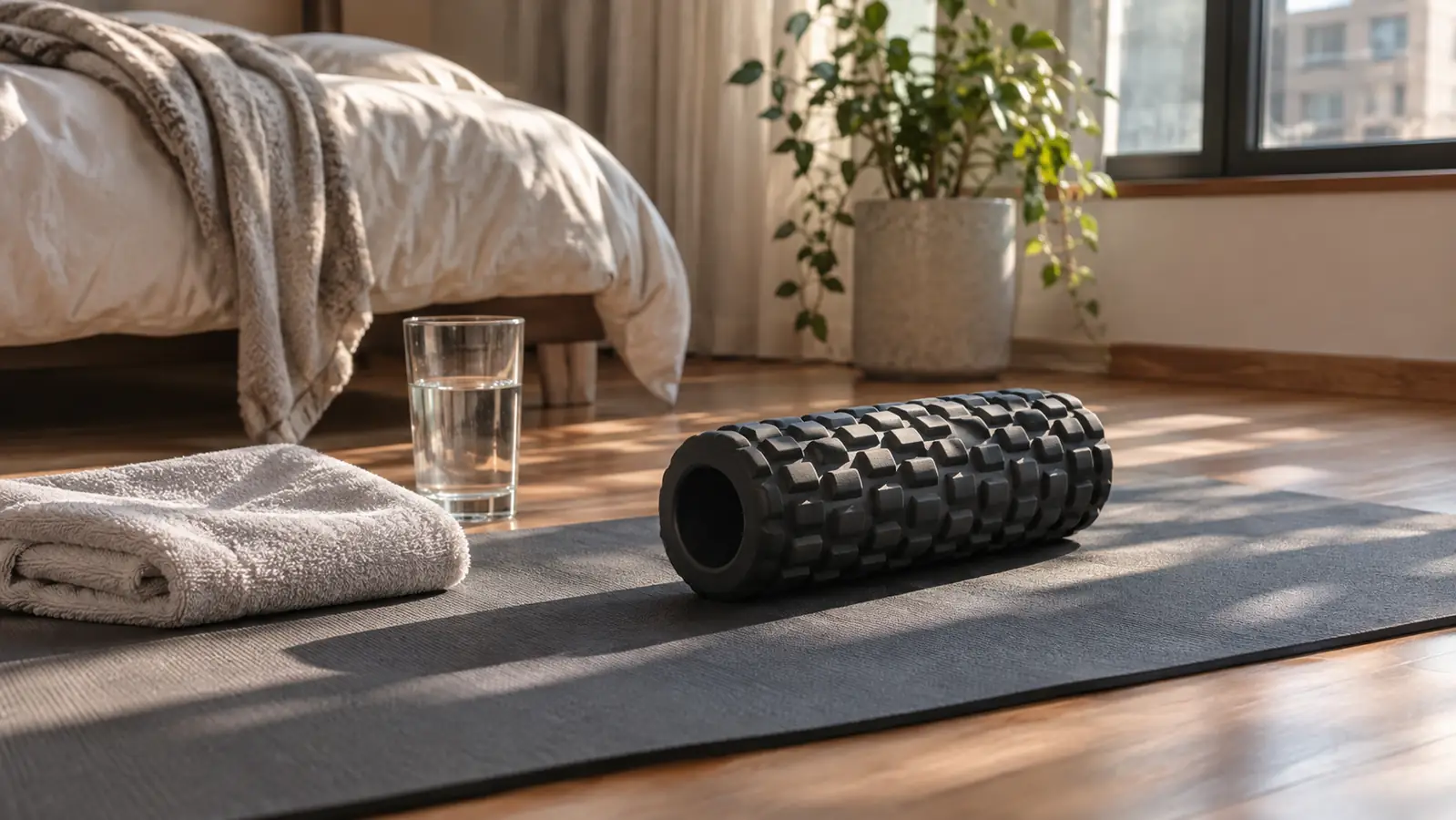
The TriggerPoint GRID is extra firm foam, 13 inches long, and about 1.1 pounds, which is light enough to carry from the living room to the bedroom mat without thinking about it. A multi-density surface of ridges and nodules gives you a few different things to lie on depending on how you turn it. I have used the same one for years.
Amazon Check Today's Price on Amazon →Step 1: Set Up the Mat Before You Lie Down
Every bad session I have had started with a bad setup. I roll on a yoga mat on the bedroom floor, not on the bed and not on the couch, because anything soft lets the roller sink and your body has to work to stay level. A firm surface lets you control how much weight goes into the roller. If the floor is hard on your tailbone, fold a towel and put it under your hips.
For the first couple of months I did this on the living room carpet, because it was there and I did not want to haul a mat out of the closet every night. The carpet looked flat enough. It was not. The roller sank about half an inch and my hips dropped with it, so every session turned into a fight to stay level instead of ten minutes of paying attention to my upper back. A cheap yoga mat on a hard floor was the fix, and it was the difference between a routine I kept and one I quit twice. If you change one thing about your setup, change this.
Lay the roller across the mat, perpendicular to the way you are going to lie. Then sit down in front of it, bend your knees, and lean back onto the roller like you are lying back onto a narrow log. You want it under your back, not under your neck and not under your waist. Starting from sitting means you never have to drop your full weight onto a hard foam surface in one motion, which is how people bruise themselves and quit after a week.
This roller is extra firm, so it does not give much. That is the point of it, but it also means a sloppy setup feels like a rock rather than a massage. Thirteen inches spans most of the width of a back, and at about 1.1 pounds it stays where you put it instead of skidding away across the mat.

Step 2: Place It Below the Shoulder Blades, Not on the Neck
The upper back, for the purposes of this routine, is the space between your shoulder blades and the bottom of your ribs. That is where the roller goes and where it stays. I never roll the back of my neck. I never put the roller on my lower back. I never let it sit directly on my spine. Those are the three rules I broke most often early on, and the neck one is the one that left me sore for two days.
The neck mistake is worth spelling out, because it does not hurt while you are doing it. The first time I let the roller creep up under my neck, it felt like relief. I stayed there, rolled gently side to side, and went to bed pleased with myself. The next morning I could not turn my head far enough to check my blind spot on the drive to work, and it stayed that way through a Wednesday and a Thursday. Now I set the roller down, sit up, and look at where it actually is before I lie back. Two seconds of checking.
On the roller itself you have a few different surfaces to choose from. The GRID has a three-dimensional pattern of ridges and nodules of varying density, so a narrow ridge feels very different from a flatter area between them. Turning the roller a quarter turn changes which of those you are lying on. My first few months I treated that as a novelty. Now I use it deliberately: flatter sections on a day when everything is sore, narrower ridges on the one spot that has been bothering me all week.
One more placement note. Keep the roller low enough that it never creeps up toward your neck while you move. If you feel it climbing, stop, sit up, and reset it. Resetting takes five seconds. A sore neck takes two days.
Step 3: Support Your Head and Keep Your Hips on the Floor
When the roller is under your upper back, your head wants to drop backward, and that is exactly the position your neck does not want to be in. Lace your fingers behind your head before you put any weight down and keep your elbows fairly narrow. Your hands are holding the weight of your head so your neck does not have to. This single change fixed most of the discomfort I had been blaming on the roller.
Where the rest of your body goes matters too. I keep my knees bent, my feet flat, and my hips on the mat, and let my upper back do the work. Some people lift their hips to increase the pressure. I do that only for a few seconds at a time, and only after I have warmed up on a flatter section. Glenn, my husband, lifts his hips the whole time and is fine. I am not, and it took me an embarrassingly long time to accept that.
If you feel pressure in your lower back rather than your upper back, your hips have probably drifted up or your knees have straightened. Put your feet back down and reset. Nothing about this should feel like a core exercise.

Step 4: Slow Down and Stay on the Spot That Catches
The spot I am after sits just to the right of my spine, about the height of the bottom of my right shoulder blade. Everyone has a version of it. You find yours by moving two or three inches at a time until something feels different from everything around it, then stopping there. Not rolling away from it. Stopping on it.
Twenty to thirty seconds is what I do. Long enough that the muscle starts to let go, short enough that I am not grinding into something irritated. Breathe out slowly while you are on it. If you notice you are holding your breath or clenching your jaw, you are pushing too hard, and the muscle you are trying to relax is bracing instead.
There was a Tuesday last winter when a colleague was out sick and I spent nine hours at the chair instead of my usual six. By the time I got home my upper back felt like one clenched fist. I rolled for twenty minutes, which at the time felt like commitment, then got up stiff and slept badly. I rolled again the next morning for another fifteen. By Thursday the whole area was more sore than it had been on Monday. What I should have done was two short holds, ten minutes of heat, and a walk around the block. I know that now. I did not know it that Tuesday.
Two or three of those holds is my ceiling for a single session. Earlier on, I would stay on one spot for several minutes because it felt productive, then get up with a back that was more irritated than when I started. Short and repeatable beats long and heroic. That has turned out to be true of almost everything I do for my back now.
Step 5: Change Your Arm Position, Then Move
Once the first spot has calmed down, change your arms. Folded across your chest, the roller sits differently against the shoulder blade. Reached overhead, it finds another set of ridges and brings the shoulder blade around the rib cage. Give each position a slow pass or two rather than trying to cover everything at once.
I finish with movement, not more rolling. Shoulder circles, a doorway stretch for the chest, and a few slow turns of my head left and right. Rolling changes what a muscle feels like for a while. Moving afterward is what tells your body the new range is safe to use. The whole routine runs five to ten minutes, and if it has gone past fifteen I have usually stopped paying attention.
I do this in the evening, on the bedroom floor, before I settle into the recliner for the night. Some people do it in the morning. The time of day matters less than doing it often enough that you notice the difference when you skip a week.
What Else Helps
I am not going to tell you a foam roller solves everything, because it does not. What has made the biggest difference alongside it, for me, is heat before rather than after. Ten minutes with a heat pack on the upper back makes the first pass on the TriggerPoint roller noticeably less sharp. Glenn does the opposite, rolls first and ices his shoulder after golf, and he is fine, so this is not a rule. It is what works on my back.
Sleep position matters more than I expected, and it took me years to connect the two. I sleep on my right side, which is the side my shoulder tightness lives on, and a pillow that lets my head drop below my shoulder line leaves me tight before I have done anything to earn it. A firmer pillow, plus one folded under my ribs to keep my spine straight, has fixed more of my mornings than any amount of rolling. It is not a roller tip, which is why it sits down here instead of in one of the steps.
The other thing that helps is walking. I walk about three miles most mornings, and on the weeks I skip it, everything in my upper back is tighter by Thursday. Gardening on the weekend is what leaves my calves and lower back sore, and those get their own few minutes on the roller rather than the same routine I use on my upper back. One roller, three different jobs.
The spot between my right shoulder blade and my spine used to feel like a knuckle. Ninety seconds on the roller most evenings is the only thing that has stayed ahead of it.
When to Stop and Ask Someone
I am a dental hygienist. I am not qualified to tell you whether the pain in your upper back is a muscle or something else, and I am not going to pretend otherwise in a paragraph. What I will say is that a roller is for everyday tightness. It is not for an injury nobody has looked at.
If rolling gives you numbness, tingling down an arm, sharp pain rather than a dull ache, or a spot that gets worse every session instead of better, stop and bring it up with your doctor. Same if the soreness came from a fall or a sudden movement rather than from a long week in a chair. I once rolled through something I should have had checked, and it cost me a month of not being able to turn my head comfortably. Ask first. The roller will still be on the mat when you get back.
Ten minutes tonight, on the floor, before the recliner
The TriggerPoint GRID Foam Roller is 13 inches, extra firm, and light enough to keep beside the chair you sit in at night. Mat, roller, ten minutes. That is the entire setup.
Amazon Check Today's Price on Amazon →