For about twenty years I ended my workday by rolling my shoulders back once, telling myself it was nothing, and driving home. By the time I reached the recliner, the spot under my right shoulder blade would be humming. I am 54, I have been a dental hygienist for 26 years, and leaning over a chair for six hours a day has left me with an upper back that behaves like a door with a bad hinge. I tried stretching. I tried a heating pad. I tried the smooth foam roller I bought years ago, used four times, and then had to push the vacuum cleaner around for the next decade.
The TriggerPoint GRID foam roller is the tool I actually kept using. Not because it fixed anything, and I will be careful about that kind of talk all the way through this piece, but because it is the first roller I did not have to argue myself into picking up. I have used it most evenings for a few months now, in the living room and on a mat on the bedroom floor, and this is an honest account of what that has looked like.
The Quick Verdict
Firm enough to matter, textured enough to find the tight spot, and stable enough that it lives beside my recliner instead of in a cupboard. My calves noticed within weeks. My shoulder took a lot longer.
Amazon Check Today's Price →If your upper back starts humming by 4pm, start here
This is the roller I reach for at the end of a six-hour day leaning over a dental chair. Extra firm foam, a ridged surface that finds the knot instead of sliding past it, and 13 inches of working area.
Amazon Check Today's Price on Amazon →How I've Used It
My routine is boring on purpose. I get home, change out of my work clothes, and sit on a yoga mat on the bedroom floor with the roller in front of me. I start with my calves, because they are the easiest thing to roll and the least likely to make me quit. Walking about three miles most mornings leaves them tight, especially the two days after I have been out in the garden. I spend roughly ninety seconds on each calf, rolling slowly from just above the ankle to below the knee, and then I move to my upper back.
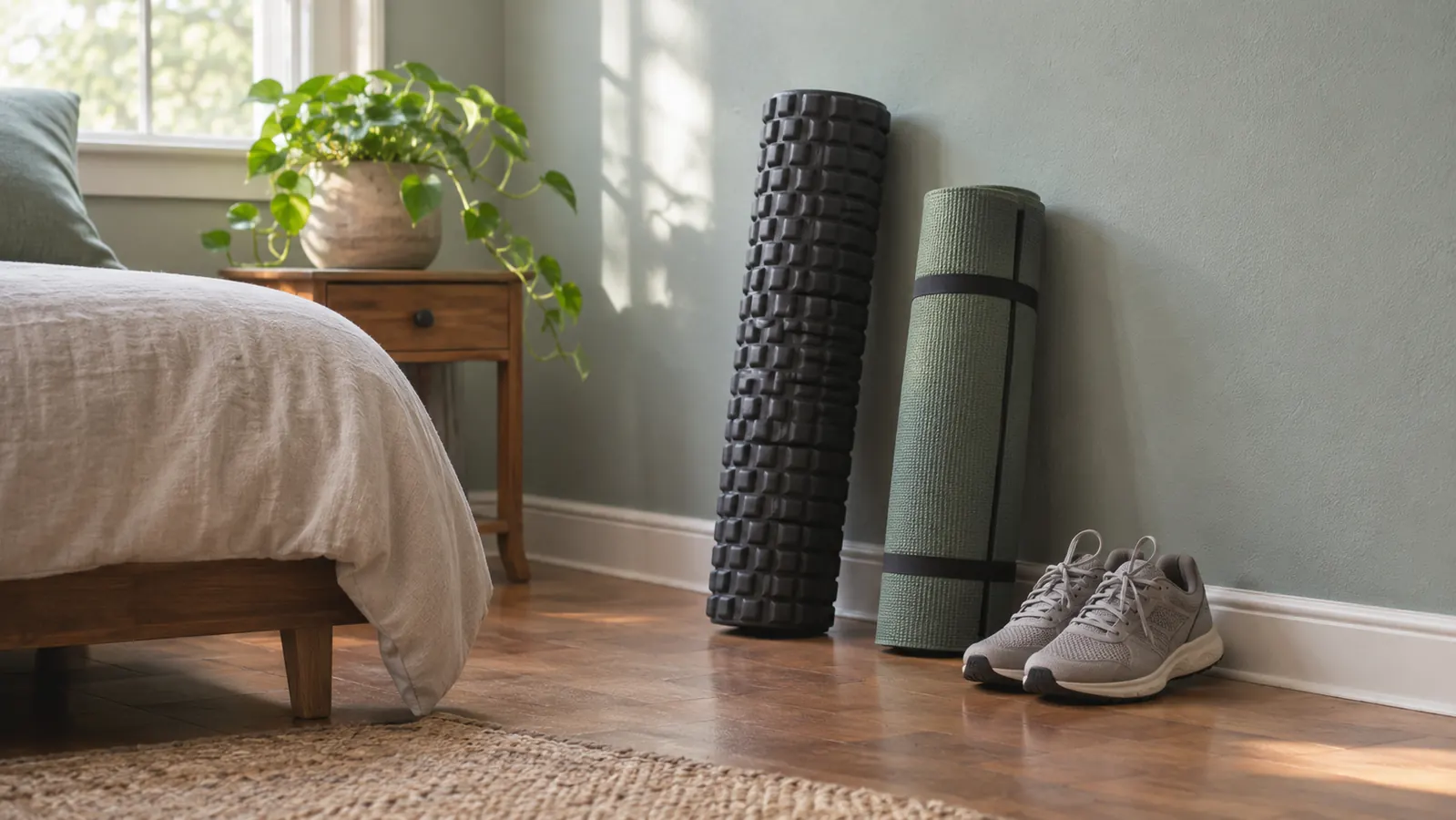
The mat is a cheap six millimeter one that stays rolled behind the bedroom door, and I set a kitchen timer for twelve minutes before I start. That sounds fussy for something so simple, but without the timer I either quit at four minutes because dinner is on, or I stay down there for half an hour and stand up stiff from the floor itself rather than from the walking. Twelve minutes is long enough for both calves and my back and short enough that I never spend the afternoon dreading it.
The upper back is the reason I own this thing. Twenty-six years of leaning over a dental chair has left my upper back, my neck and my right shoulder tight in a way that is more grinding than dramatic. I lie on the floor with the roller across my mid-back, perpendicular to my spine, hands behind my head, and I move slowly. I do not roll my lower back. I did that once, years ago, felt a pinch, and decided that was a conversation for somebody with a license. I work the muscles beside the spine, never on the spine itself.
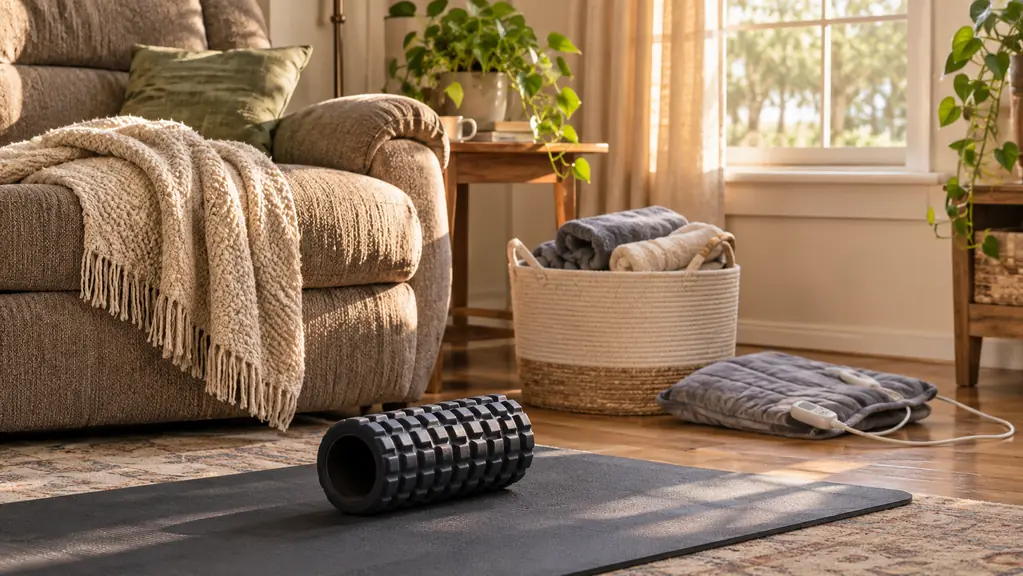
Glenn, my husband, uses it too, though he would never put it that way. He is 58, retired, and plays golf most weekends, and after a round his hips and shoulders are stiff enough that he will quietly carry the roller over to the mat and work on his right hip for ten minutes while the coffee is going. He calls it the knobbly thing. We keep it in a canvas basket beside the recliner with the heating pad and a couple of rolled towels, which means it is within arm's reach at eight in the evening when I am tired enough to skip it. That placement matters more than any feature on the box.

What the GRID Surface Actually Feels Like
The GRID is not a smooth cylinder of foam. The surface carries ridges and raised nodules in a pattern the manufacturer calls Distrodensity Zones, and the foam is multi-density, which means some parts of that surface give more than others. TriggerPoint describes the three-dimensional surface as built to replicate the feeling of a massage therapist's hands. I am not a massage therapist and I would not go quite that far, but I understand why they say it.
Here is what it feels like in practice. Instead of one flat band of pressure across the whole width of the muscle, you get a few distinct points of pressure that shift as you roll. On my calves, that is the difference between a vague squeeze and something that actually finds the tight place. On my upper back, the ridges catch along the edge of the shoulder blade, which is intense for the first ten seconds and then eases. I breathe out and let it. If I tense up, it just hurts and nothing loosens, which is the same lesson I have learned about flossing and about most things.
The first time a ridge caught the edge of my shoulder blade, I yelped and rolled straight off it. Glenn looked up from the kitchen to see what had happened. It took me three or four evenings to work out that the move is to stop on the tight place instead of rolling away from it, breathe out slowly, and let the muscle give before I travel another two inches. Now I can tell I have found the right spot before I feel anything, because my breathing changes first.
The foam is firm. The listing says extra firm and that is accurate. My first week, I rolled my calves with both feet flat on the floor and my full weight pressing down, and it was too much. A friend who does triathlons told me to take some weight off through my hands and let the roller do less work while I got used to it. That one change is the reason I am still using it. A softer roller would have been gentler, but I have owned a soft one and I stopped feeling it after a month, which is why it lives in the garage now.
What Changed Over a Few Months
I want to keep this honest, so here is what I can and cannot say. I cannot tell you the roller fixed my shoulder. I am not a physical therapist, I am not a doctor, and I have no way to separate the rolling from the walking, the gardening, the way I sit, or the fact that I started paying attention to my posture at work. What I can tell you is that the point under my right shoulder blade used to start humming around four in the afternoon. It now shows up less often, and later in the day.
I started in the second week of March and kept a note taped to the fridge for the first month, because I do not trust my memory about this kind of thing. The note said the same sentence for twenty-eight days: calves fine, shoulder humming by four. Somewhere in the fifth week the sentence stopped being true often enough that I quit writing it down. That is not a dramatic result, but it is the sort of change I would never have noticed without the note.
My calves are the clearest change. After three miles they used to feel like they belonged to somebody else for a day and a half. Now I roll them for a few minutes in the evening and the next morning they feel like mine. That is not a dramatic claim. It is just the thing I notice most, and it is why the roller stays out on the mat instead of going into a cupboard.
The other change is smaller and harder to describe. Rolling forces me to lie on the floor for ten minutes and do nothing else. I am not someone who sits still well. I have started to think of it as the ten minutes where I am not allowed to answer anything, and I suspect that is doing as much for my neck as the foam is.
What I Got Wrong at First
I rolled too hard. That is the whole thing. When you first get a firm roller with ridges, the instinct is to put all your weight on it and go fast, because fast feels like productivity. Fast does nothing. The tight spot wants you to slow down, settle onto it, breathe for a count of five or ten, and then move a couple of inches. Once I started doing that, sessions got shorter and more useful.
I also got the speed wrong for the first ten days or so. I counted in my head and ran the whole length of a calf in about eleven seconds, which is not rolling, it is rubbing foam on a leg and calling it a routine. I now move roughly an inch every two or three breaths. That means one calf takes the better part of ninety seconds, and I can tell you exactly where along the muscle I am instead of just going back and forth until the timer beeps.
I also rolled my lower back, once, which I have already mentioned and will mention again because I see people do it. You will find out quickly whether that is a good idea for you. It was not for me. My rule now is calves, the outside of the thighs, the muscles on either side of the spine, and the upper back. Anything that feels like it might be a joint, a bone or a nerve gets left alone.
The third thing I got wrong was expecting a timeline. I had this idea that after two weeks I would feel different. It was closer to six or seven weeks before I could say anything beyond that it felt nice at the time. If you are the kind of person who needs a result by Friday, this is going to be a frustrating object to own.
What It Doesn't Do, and When I Stop
It does not replace anybody with a license. I say that as someone who spent years ignoring her own advice. If something is sharp, or numb, or waking you up at night, a foam roller is not the answer and rolling harder on it is worse than doing nothing. I have a doctor. I did a stretch of physical therapy for the shoulder a while back. The roller sits downstream of both of those, not in place of them.
It also does not travel especially well. At 13 inches long and about five inches across, and a little over a pound, it is fine in a gym bag and awkward in a carry-on. I took it to a hotel twice and both times I questioned whether it earned the space. For travel, something smaller would probably win.
And it is not a soft landing. If your idea of recovery is warm and gentle, this is the opposite of that. The same firmness that makes it useful on my calves is the firmness that made me mutter at it during the first week. I wipe it down with a damp cloth every few days, mostly because it sits on the floor, and that is the entire maintenance routine.
What I Liked
- Extra firm foam that has not softened into uselessness after months of near-daily use
- The ridged, multi-density surface finds tight spots a smooth roller slides straight past
- 13 inches of working area covers a calf, a thigh or the upper back without constant repositioning
- A little over a pound, light enough to move from the mat to the recliner one-handed
- Simple to clean and impossible to break, so there is nothing to fiddle with before you start
Where It Falls Short
- Painful in the first week if you roll with your full body weight on it
- Too firm for anyone who wants gentle, comforting pressure
- Awkward in a carry-on, so it is not really a travel tool
- Does nothing on its own if you will not slow down and breathe into it
- You have to work out your own routine, because the roller arrives with no guidance
Six or seven weeks in, my calves stopped feeling like they belonged to somebody else the day after a three mile walk.
Who This Is For
This is for someone with everyday tightness, not an injury. The person who leans over a chair, a keyboard or a steering wheel all day and has a spot between the shoulder blades that announces itself by late afternoon. The person who walks or gardens or plays a weekend sport and wakes up the next day feeling ten years older in the calves and hips. If that is you, and you are willing to spend ten quiet minutes on the floor most evenings for two months before you judge it, this roller will earn its place.
It also suits a household rather than a single person. Between my upper back and Glenn's hips after golf, one roller in a basket by the recliner gets used by two people most days of the week. I like that I did not have to buy anything with a cord, a battery or an instruction manual to get that.
Who Should Skip It
Skip it if you want something soft. If your ideal is a gentle roll before bed that feels like being petted, this is not that object and you will resent it. Skip it if you have an actual injury, a joint issue, or pain that is sharp or numb or wakes you at night, because the correct next step there is a professional, not a firmer piece of foam. And skip it if you know yourself well enough to know you will not lie on the floor for ten minutes. The best roller in the world does nothing from inside a cupboard.
One more: if you are looking for a travel tool, buy something smaller. The 13 inch TriggerPoint is a living room tool. It lives where you live, and it is very good at that job, but it is not going in a suitcase without an argument.
The one recovery tool that earned a spot by the recliner
Extra firm, ridged, 13 inches, a little over a pound. Months in, it is still the first thing I pick up after a day of leaning over a dental chair, and the only one Glenn borrows without being asked.
Amazon Check Today's Price on Amazon →