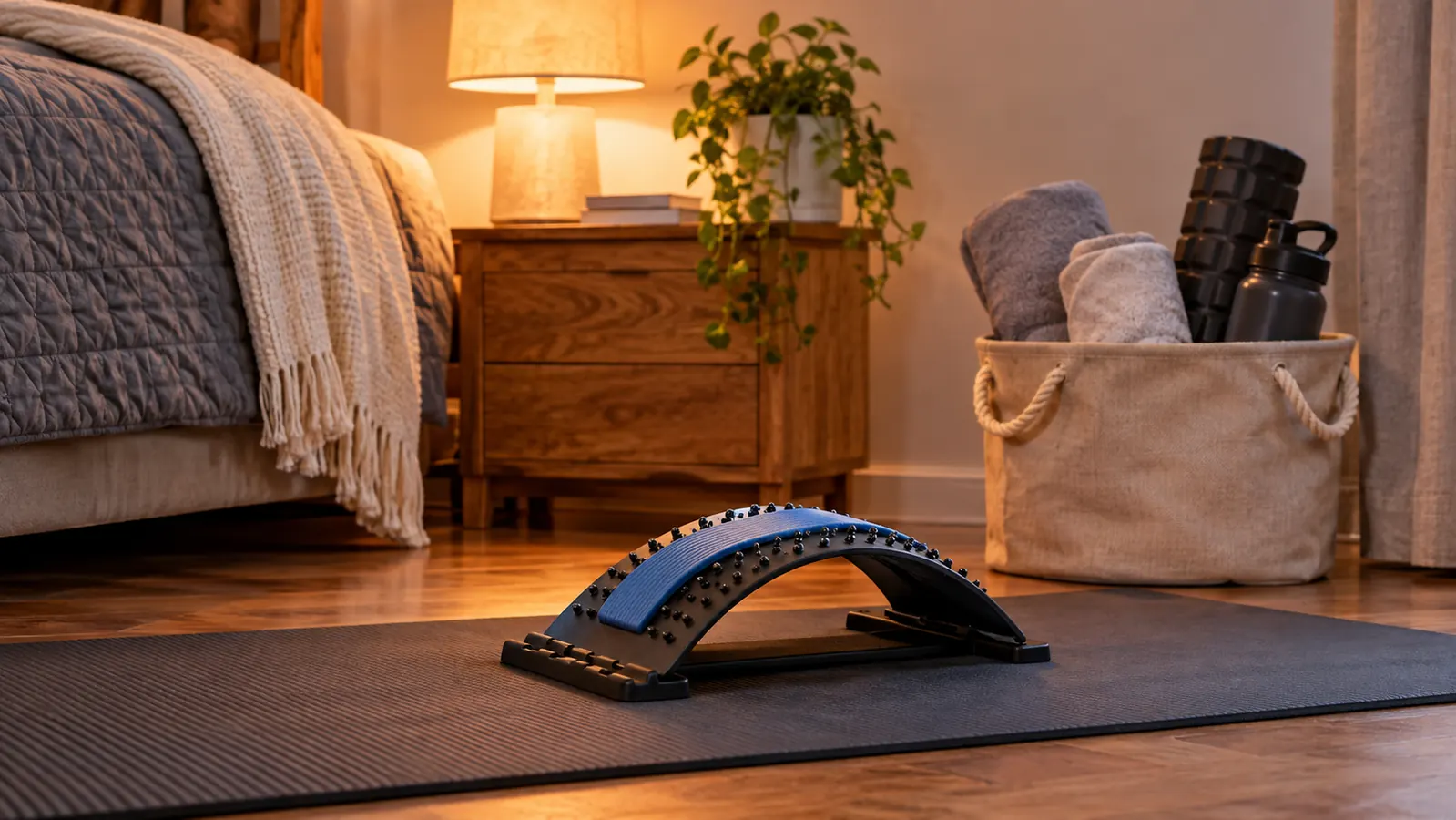
In the canvas basket beside my recliner there are two things I reach for on a sore evening. One is the Magic Back Support Back Stretcher, a small board I lie back over. The other is a plain foam roller. I have spent 26 years leaning over a dental chair, which leaves my upper back, neck and right shoulder tight by about four in the afternoon. I walk three miles most mornings and I garden on weekends, which adds my calves and my lower back to the list. So I have had a fair amount of time to notice which tool does what. If you are choosing between the two, they overlap far less than the marketing suggests.
Short answer: if your trouble is the lower back and the stiffness that builds from sitting, the Magic Back Support Back Stretcher fits better. It is a small board, 6.3 by 3.94 by 0.71 inches and 1.54 pounds, made of ABS, with multi-level height adjustment. You set the level, lie back, and your own body weight does the rest. No power, no battery. If your trouble wanders, calves after a walk, hips after a round of golf, that spot between the shoulder blades, a foam roller fits better and I would not want to be without mine. Which one belongs in your house depends on which of those two weeks sounds more like yours.
| Magic Back Support Back Stretcher | High-Density Foam Roller | |
|---|---|---|
| Lower back | Multi-level height adjustment sets how far your back extends, and your own body weight supplies the pressure | You roll the muscles beside the spine, not the spine itself |
| Upper back and shoulder blades | The board is 6.3 inches wide, so it works under one area at a time | A long cylinder spans both shoulder blades at once |
| Calves, thighs and hips | A flat board that works under a back rather than wrapping around a limb | A cylinder wraps a leg, which is exactly what it is for |
| Where you can use it | Bed, chair, car or floor, per the listing, at 1.54 pounds | Floor only, with room to roll |
| Changing the intensity | Move up a level. Nothing extra to buy | Change how much weight you put through it, or buy a firmer one |
| Material and wear | ABS, with no foam to soften over time | Foam compresses where you use it most |
| Time per session | Two minutes lying still | Five to ten minutes working along a muscle |
| Storage | 0.71 inches thick, so it slides under the bed or into a bag | A long cylinder that lives in a corner |
Where Magic Back Support Back Stretcher Wins
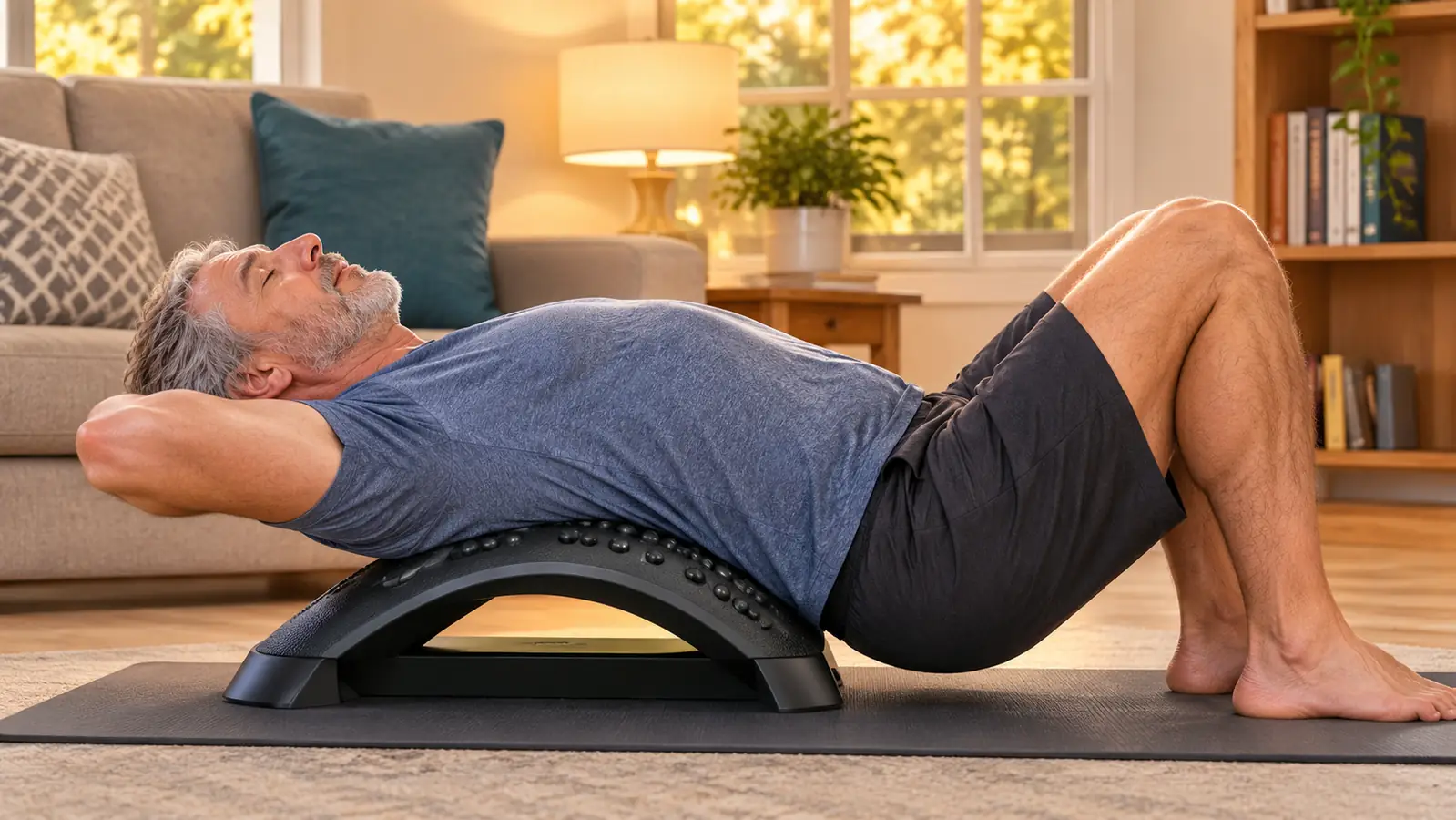
The first place it wins is the lower back, and it wins by doing something the roller cannot. A foam roller works on muscle you can get on top of. The board works on the position of your spine. You lie back over it, the adjustable levels change how far your back extends, and your body weight supplies the pressure. After a garden Saturday, when my lower back is tired from bending and pulling, two minutes at a low setting does more for me than ten minutes of rolling ever has. I am not a physical therapist and I will not dress that up as treatment. It is a tool that makes a stiff back feel less stiff, and it does that part well.
The second place it wins is inconvenience, which matters more than people admit. The board is 0.71 inches thick and 1.54 pounds, so it goes on the bedroom floor, on the recliner, into the car for the drive home from my mother's, and back into the canvas basket without a production. The listing says bed, chair and car, and in my experience that is accurate. I keep it by the recliner because a tool that lives in the closet never gets used. Glenn takes it out to the patio after golf, sets it on a chair and leans back over it for his mid back. The foam roller stays on the bedroom floor and gets used when I remember.
The third place is wear. ABS does not go soft. The roller I bought three years ago has a flattened patch where my right glute sits, and I can feel it. The board looks the same as the week it arrived, which is a boring thing to like about a product and also the reason it is still in the basket.
Where a Foam Roller Wins
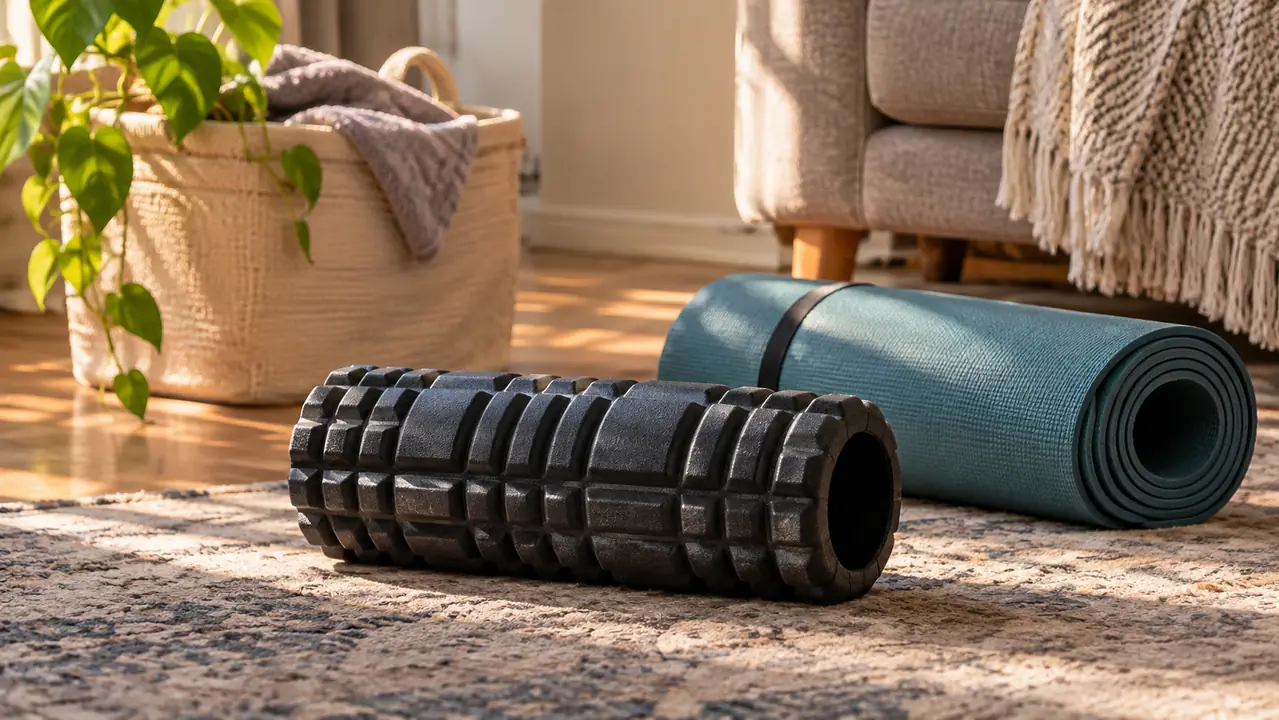
The roller wins anywhere the body part is round and the tool needs to wrap it. Calves after three miles. The outside of a thigh. Glutes after a weekend of weeding. My right shoulder blade area, which is a spot the board cannot reach at all, because the board is 6.3 inches wide and sits under one area at a time. A long cylinder spans both shoulder blades, you lie on it, and you can work left to right. That is a real advantage and there is no version of the board that does it.
I found that out the hard way on a Saturday in April. I had spent the afternoon edging two beds and hauling mulch bags from the driveway, and by evening the tight spot had settled between my right shoulder blade and my spine, right where my own hand cannot reach. I lay on the board first because it was closest, and it did nothing for that spot at all. Then I lay on the roller with my arms crossed over my chest and worked left and right until it eased. Twenty minutes with the wrong tool would have been worse than none.
The roller also lets you hunt. When a knot has a specific address, rolling lets you slow down, backtrack and stay on it for thirty seconds until it lets go. The board is a fixed position. You lie on it and you wait, and the level either suits the day or it does not. There are evenings I want to hunt and there are evenings I want to lie still with my eyes shut, and most people past 40 know the difference without being told.
The Board That Lives by the Recliner, Not in the Closet
At 0.71 inches thick and 1.54 pounds, the Magic Back Support Back Stretcher goes to the chair, the car and the bedroom floor with you. Multi-level height adjustment means day one does not have to hurt.
Amazon Check Today's Price on Amazon →Two minutes one level up from the bottom does more for my four o'clock lower back than ten minutes of rolling ever has.
What a Week of Each Felt Like
Week one I used only the Magic Back Support Back Stretcher, two minutes in the morning and two at night. The first minute is the honest part. Your back is not sure about it and you feel every bit of the extension. Then it settles, and the second minute is almost pleasant. On the Monday I could only manage about ninety seconds before I sat up. By the Wednesday I was doing the full two minutes without watching the clock, and by the Saturday I had stopped bracing my shoulders, which was the thing making it feel harder than it was. By Thursday I had stopped thinking about it and started looking forward to it, which is the only test of a recovery tool I trust.
Week two I used only the roller, five to ten minutes a night on the mat. Calves, both hamstrings, glutes, then a slow pass along the upper back. My legs felt better after the morning walk and my shoulder blades loosened. My lower back did not change much at all. That surprised me, because rolling feels like more work and I assumed more work meant more result. Ten minutes on the floor after a long day is also a bigger ask than two minutes in the recliner, and there were two nights I skipped it entirely.
By the Friday of that week I had learned to leave the roller where I would trip over it, which in my house means the edge of the bedroom rug rather than folded against the wall. I also timed it once out of curiosity. Eight minutes for calves and hamstrings, six for the upper back, and the whole business felt like a chore by the fourth night. The board never feels like a chore, because it is over before I have finished deciding whether I want to do it.
Week three I stopped choosing. Board first, two minutes, while the kettle boils. Roller after, but only for the legs and the shoulder blades. That is the arrangement that has survived, and it is why I have a hard time calling one of these better than the other. The board is the one that changes how my back feels. The roller is the one that reaches the parts the board cannot.
What I Got Wrong First
I started at the highest level because I am 54 and impatient. That was a mistake. Nothing terrible happened, but I spent a week bracing instead of relaxing, which defeats the whole point. The multi-level adjustment exists precisely so you do not have to be a hero on day one. Start at the lowest setting, stay there until it feels like nothing, then move up. I gave that first stretch eleven days rather than seven, because my back is 54 years old and does not negotiate. The same logic applies to the roller. A softer one is not a beginner's indulgence, it is how you avoid bruising yourself into quitting.
I also bought a cheap smooth roller first and disliked it, because it was too soft and bottomed out under my weight inside a month, which is how I ended up with a firmer one. That small lesson cost me a return and a trip to the post office. The board had no such learning curve, because there is not really a wrong version of a flat piece of ABS with a height adjustment on it.
The other thing I got wrong was rolling my lower back directly. It felt productive and it was not the right use of a foam roller for me, so I stopped, and now I roll the glutes and the muscles to the side instead. I will say plainly that I am a dental hygienist, not a massage therapist, a physical therapist or a doctor. Anything that is injured, anything sharp rather than dull, anything that runs down a leg, gets a call to my doctor before I put a tool on it. These are tools for everyday stiffness, not for the things that need a professional.
The Two Things Neither One Fixes
Neither tool fixes 26 years of leaning over a chair. What fixed the source was raising my monitor, moving the suction lines where I could reach them without twisting, and standing up between patients even when the schedule did not invite it. The board and the roller make the end of the day more comfortable. They do not undo the day.
And neither one does anything if you do not use it. I have bought recovery gadgets that lived in a drawer for a year. The reason these two survived is that the board asks two minutes and the roller asks ten, and both sit in plain sight. If a tool requires assembling, charging or clearing a space, it is competing with the recliner, and the recliner wins.
The other thing I would say is that neither tool replaces the three miles I walk most mornings. On the weeks I skip the walk because it is raining or because I am running late, both tools do noticeably less for me. The walking is what keeps everything loose enough for the tools to be useful at all. If someone told me I had to give up either the board or the walk, I would keep the walk and lie on the floor with a rolled towel instead. Glenn says the same about his golf, though I notice he still takes the board out to the patio afterward.
Who Should Buy Which
Buy the Magic Back Support Back Stretcher if the stiffness collects in your lower and mid back, if you sit for a living, and if you know yourself well enough to admit that a tool you have to unroll on the floor will get used twice. It is small, it weighs 1.54 pounds, it lives by the chair, and it takes two minutes. That combination is why it stays in my rotation.
Buy a foam roller instead if your soreness moves around, if you walk or run or play golf, or if the spot between your shoulder blades is the thing that bothers you most. If you can honestly say you will spend ten minutes on the floor most evenings, the roller will earn its space. If you cannot, start with the board and add the roller later. Glenn uses both, the board on a chair for his mid back and the roller on the floor for his hips after golf, and he is not what you would call a disciplined man about either.
Start at Level One, Not Level Three
The Magic Back Support Back Stretcher needs no power, adjusts across levels so the first week stays gentle, and slides under the bed at 0.71 inches thick. Mine lives in the canvas basket by the recliner.
Amazon Check Today's Price on Amazon →