I wanted to like the TriggerPoint GRID before I ever lay on it. That is the part I should admit first. I had read the listing, watched the clips of people rolling out their quads in bright gyms, and decided that a firm roller was the thing my back had been missing for years. Then I put it under my upper back on a Tuesday evening in my living room and lasted about forty seconds before I got up and put it in the closet. This is the honest version of what happened after the closet, including the parts the product page does not mention.
Some context, because a tool like this only makes sense against a specific body. I am 54, I live in Greensboro, North Carolina, and I have spent 26 years leaning over a dental chair, which has left my upper back, neck and right shoulder tight most days. I walk about three miles most mornings and I garden on weekends, so my calves and lower back complain about both. I am not a physical therapist, a chiropractor or a massage therapist and I do not write like one. What I can tell you is how a piece of molded foam felt under my own shoulder blades for six months.
The Quick Verdict
A well-built, genuinely firm roller with a surface pattern that reaches spots a smooth cylinder glides over. It rewards slow, patient use and punishes enthusiasm in the first week, which is why it suits experienced rollers far more than beginners.
Amazon Check Today's Price →The first week is the worst week. Here is what comes after it.
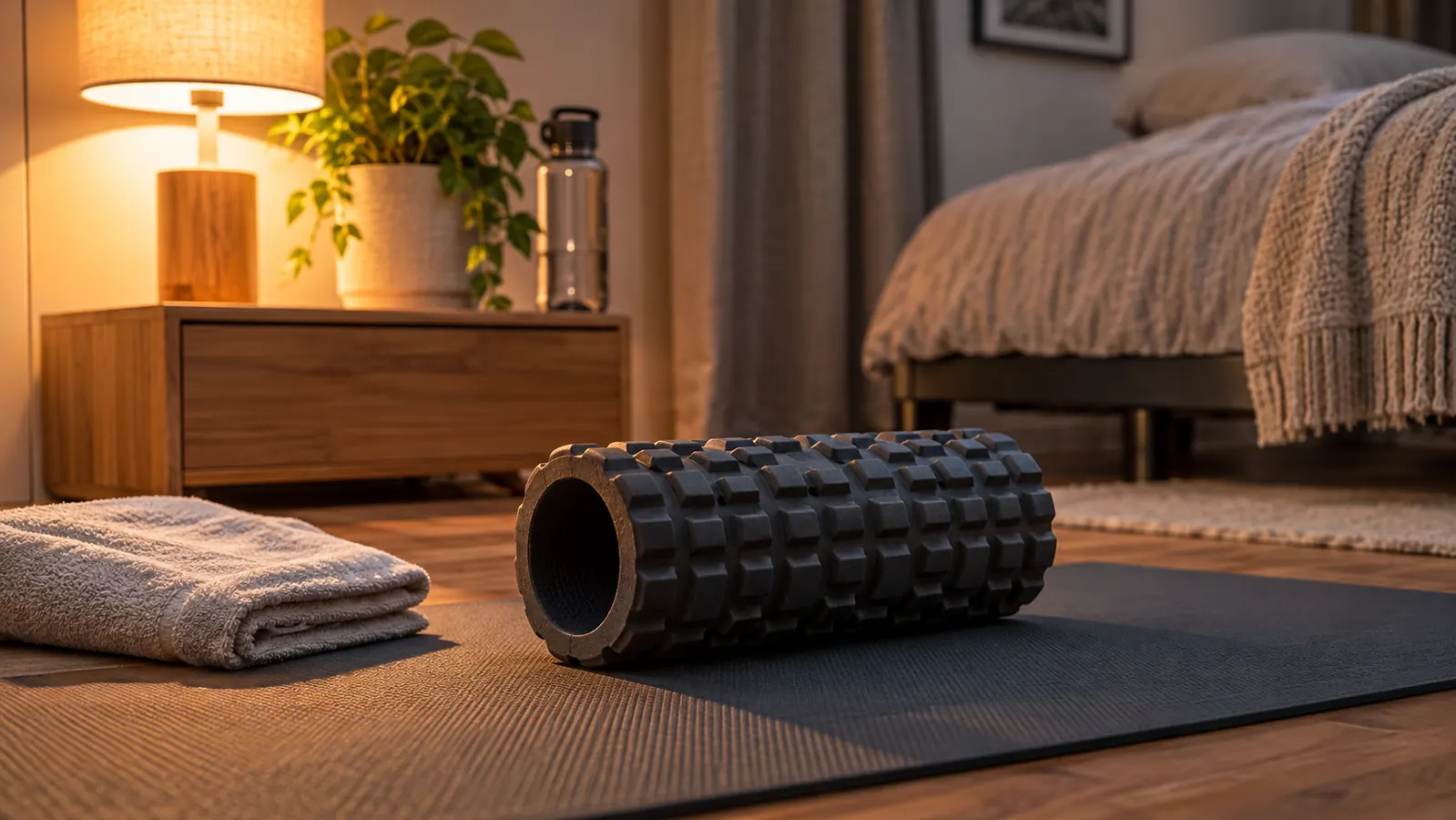
Thirteen inches long, 1.1 pounds, and rated extra firm by a company that is not exaggerating. If your upper back has been quietly tightening for years, this is worth ten minutes of your evening.
Amazon Check Today's Price on Amazon →Why the First Week Went Badly
I did three things wrong, and every one of them is what a person does with their first firm roller. I rolled too fast. I rolled too long. And I rolled directly over spots that were already irritated instead of working around them. Forty seconds of fast rolling on a surface covered in ridges and nodules is not a massage, it is an argument. My right shoulder blade felt worse that night than it had in months, and I blamed the roller, which was unfair, because it had done exactly what a firm textured object does when you drive your full bodyweight across it at speed.
The second attempt came three weeks later and it was almost accidental. A coworker at the practice mentioned that she had stopped rolling her whole back and started holding still on one tender spot for a slow count of twenty. I tried the same thing, on the same roller, on the same floor, and got a completely different result. What I had been missing was not a softer tool. It was a slower plan and a hard rule that ten minutes is plenty.
How I Actually Use It Now
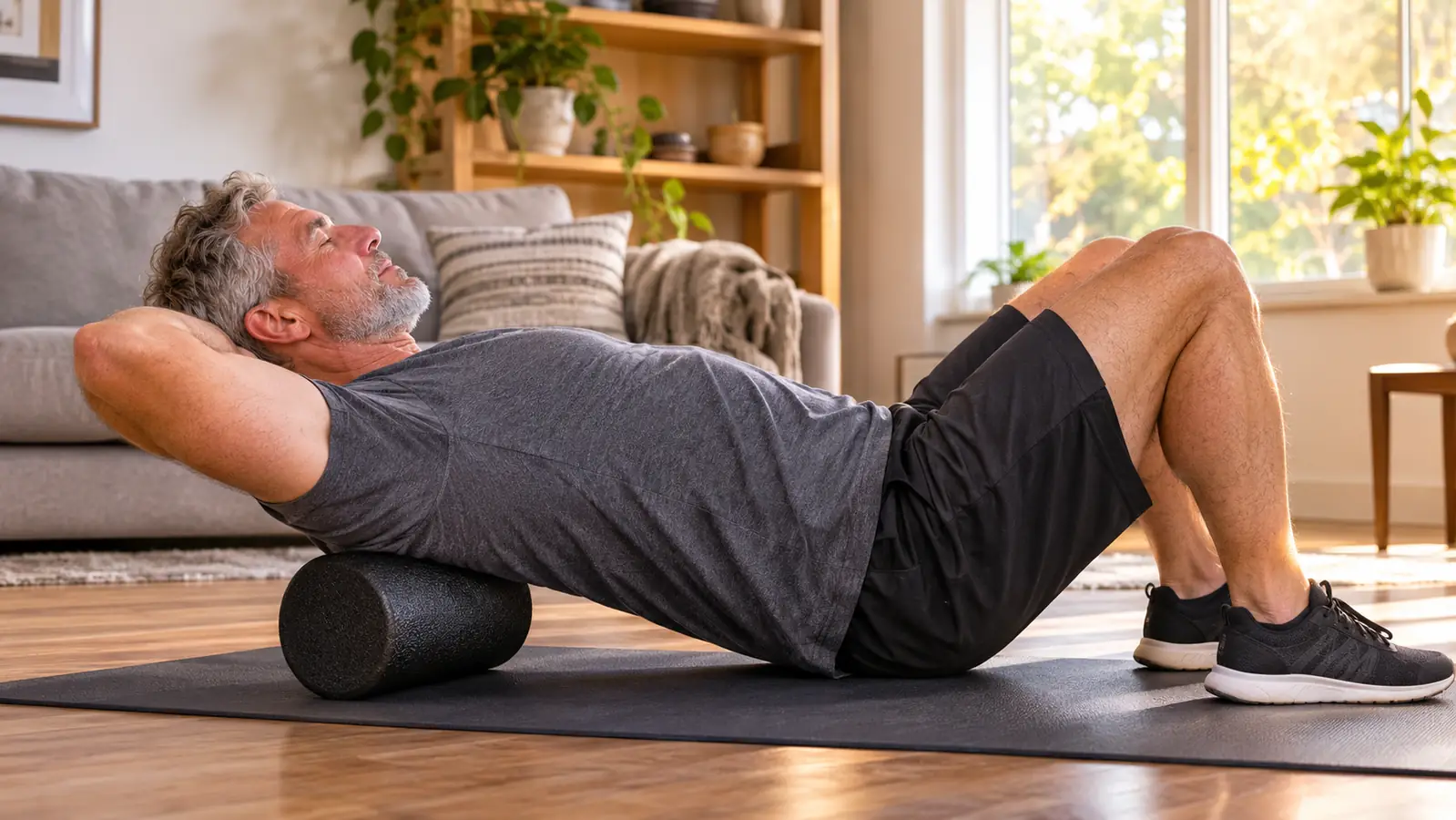
Most weeks I use it three or four evenings, for eight to twelve minutes, on a yoga mat on the bedroom floor. I start with my upper back, holding the roller slightly to one side so it sits under the muscle rather than on the bone. I move about an inch a second, which feels absurdly slow, and when I find a spot that complains I stop there and breathe for twenty or thirty seconds before moving on. Then I do my calves, one leg at a time, with the other foot flat on the floor for balance.
Glenn borrows it after golf. He is 58, he plays most weekends, and the outside of his thighs and his hips are what bother him. He uses it against the wall standing up for his hips, which I have never tried, and on the floor for the outsides of his legs, which is the loudest ten minutes of our week. Watching him taught me something I would not have guessed: a firm roller forgives a heavier person, because body weight does more of the work and the arms do less.
The roller technically lives in the canvas basket beside the recliner with the rest of my things. In practice it stays on the floor between sessions, because picking it up and putting it away is enough friction to make me skip an evening. That sounds trivial and it is the single biggest difference between a recovery tool that gets used and one that gets stored, so if you buy this, decide where it will sit before it arrives.
What the Multi-Density Surface Actually Does
The GRID is not a smooth cylinder. The surface carries a three-dimensional pattern of ridges and nodules at varying densities, what TriggerPoint calls Distrodensity Zones, and that pattern is the whole reason to choose this over a plain foam tube. Some bands are flatter and feel firmer, some are raised, and the difference under your back is not subtle. On my mid-back the flatter bands let me settle and breathe. The raised bands feel like a thumb that will not let up, which is the point.
Here is the honest downside nobody puts in a listing. A variable surface is wonderful on the meaty parts of you and too much on the bony ones. I cannot use this over my shin bone at all, and I have tried. On my calves, the outside of my thigh and my upper back, the pattern earns its keep, because it presses in different places as the roller turns and finds bands a smooth roller slides straight past. On anything close to the surface, it is simply too aggressive.
The foam has held up better than I expected. Six months in, used three or four times a week by two people, it has not flattened, softened or developed a groove. It weighs 1.1 pounds, so moving it between the bedroom and the living room is nothing, and a damp cloth deals with it after a session on a floor that has seen better days.
The ridges are not decoration. On my mid-back, the difference between a flat band and a raised one is the difference between a two minute pause and a ten second pass.
Extra Firm Is a Commitment, Not a Selling Point
The listing says extra firm and the listing is telling the truth. This is not a roller you lie on and relax into. There is no give in it, so the first few seconds over a tight spot are unpleasant in a way that is hard to describe without sounding dramatic. The instinct is to roll faster to get it over with, and faster is exactly wrong, because speed turns pressure into a scrape. If you have ever pressed a knot with your thumb and pulled away, this is that sensation spread across the width of your back.
Two people will read that paragraph and have opposite reactions, so let me be direct. If you have been foam rolling for a year on a soft roller and getting almost nothing from it, extra firm is the upgrade you are looking for. If you have never foam rolled, this is a hard first tool. Not dangerous, just hard. A softer roller first and this one second is the more comfortable path, and knowing what I know now, I would take it.
Firmness also changes how a session works, which caught me out. Because the roller does not compress, all of the movement in a session comes from you. Nothing absorbs a careless shift, so rolling off the edge of your back too quickly is felt immediately. Twice in my first month I finished with a tender spot that lasted into the next morning, and both times the cause was my own speed. I have not had one since I slowed down.
How It Compares to a Plain Foam Roller
Glenn had a smooth roller in the garage for years and used it maybe twice. The GRID gets used because it does something the smooth one cannot, and I think that is the honest case for it. A plain roller works on the broad surface of a muscle and glides over the tight bands inside it. The raised pattern on this one catches those bands and holds pressure on them as the roller turns, which is the closest thing to a thumb I have found in a piece of foam.
The trade works in the other direction too, and this is where a smooth roller wins. For anything bony, for the neck, for a first attempt at rolling at all, smooth and softer is better. If I could only own one, and I had never rolled before, I would own the smooth one. Owning both is not extravagant at this size, since the GRID takes up less floor space than a pair of shoes.

Where It Falls Short
Length is the first limitation. Thirteen inches covers a section of your back, not the length of it. If you want to lie lengthwise with the roller running head to tail, you will be hanging off one end no matter how you arrange yourself. Side to side across the upper back it is fine, and for calves it is more than enough. For what I think of as full spine lying, it is not the tool, and I will not pretend otherwise.
The bony areas are the second limitation and the one I did not see coming. The same ridges that make my upper back feel worked make my shins feel punished, and if you are lean or have prominent shoulder blades, the texture will find every edge. I do not think that is a design flaw so much as a design choice with a cost. It is also the reason a second, softer roller is a sensible purchase rather than a fussy one.
The third is that the roller does not teach you how to use it. There is no routine printed on it and no guidance about speed or duration, so you learn from reading or, more likely, from overdoing it once and working it out afterward. That is true of nearly every roller on the market, but at this firmness the cost of not knowing is higher, which is why so much of this review is about technique.
What I Liked
- Extra firm surface keeps its shape, so body weight does the work instead of tired arms
- The raised pattern of ridges and nodules reaches bands a smooth roller glides past
- 13 inches long and 1.1 pounds, easy to store and carry between rooms
- No softening or grooving after six months of hard use by two people
- Covers the upper back, calves and outer thighs, which is most of a home routine
Where It Falls Short
- Too aggressive as a first foam roller, the learning curve is real
- The texture is uncomfortable over shins and other bony areas
- 13 inches is short for lying on it lengthwise along the spine
- No give at all, so every careless shift is felt immediately
- Technique has to be learned from somewhere other than the product
Six Months In, and What Changed
The change is not in the roller, it is in me. I no longer think of a session as a workout or a fix. I think of it as ten quiet minutes on the bedroom floor, and the effect on my upper back is that it stops shouting by Thursday instead of Friday. My right shoulder still tightens during long appointment days. The roller did not solve that and I never expected it to. It made the tightness something I can handle at home between the things that actually address it.
Glenn's verdict is shorter than mine and worth including. He says it is good for his hips against the wall, that the outside of his thigh is the spot that needed it most, and that it is too hard to lie on straight after a round of golf when everything is already irritated. He also says it is the only recovery item I have bought that he has asked to borrow, which is either praise for the roller or an indictment of the rest of my basket.
What It Did Not Do
Nothing about this roller is a treatment, and I want to be careful about that. It did not fix my shoulder, it did not undo 26 years of leaning over a chair, and it does not replace the massage therapist whose hands find things foam cannot reach. What it does is buy me a slightly easier Thursday. That is a smaller promise than the listing makes and, in my experience, a more honest one.
If you are expecting the roller to stand in for strength work, a properly fitted chair, or a professional opinion about pain that has been around for months, it will disappoint you. I still do the boring things: the chair at the right height, the short breaks between patients, the walk at lunch. The roller sits on top of that list rather than replacing it, and it works better the more of the list I actually do.
Who This Is For
This is for someone with an ongoing, specific tightness in the meaty parts of the body, the upper back, the calves, the outer thighs, who has already tried a softer roller and found it too gentle. It suits people who will get down on the floor for ten minutes three or four times a week and who are willing to be uncomfortable for the first week while they learn to slow down. It also suits a two person household, because it holds up to being used hard by both of you.
It suits you more if your bodyweight is on the higher side, since firmness gives control rather than taking it away. It suits you less if you want something to use on your neck, because I do not and I would not suggest it. And if you have an injury, a flare up, or pain that has been getting worse rather than better, that is a conversation with your doctor rather than a purchase, whichever roller you end up with.
Who Should Skip It
Skip it if this would be your first foam roller. The extra firm surface is unforgiving while you are learning, and most people who give up on rolling give up in the first two weeks, which is exactly when the GRID is at its least friendly. Start softer, learn what ten slow minutes feels like, and come back to this one when a soft roller has stopped doing anything for you.
Skip it if your tightness sits in bony areas, or if you want a roller long enough to lie on lengthwise. Skip it if you want a tool that doubles as a cushion or a stretching aid, because it does neither. And skip it if what appeals to you is the idea of rolling rather than the practice. This is ten to fifteen minutes of your week that somebody has to decide to spend, and the TriggerPoint GRID will not make that decision for you.
Firm enough that you will know by the second week whether it suits you
Thirteen inches, 1.1 pounds, extra firm, and rated 4.7 by more than 23,000 people. Mine has not softened in six months, and Glenn still has not given it back.
Amazon Check Today's Price on Amazon →