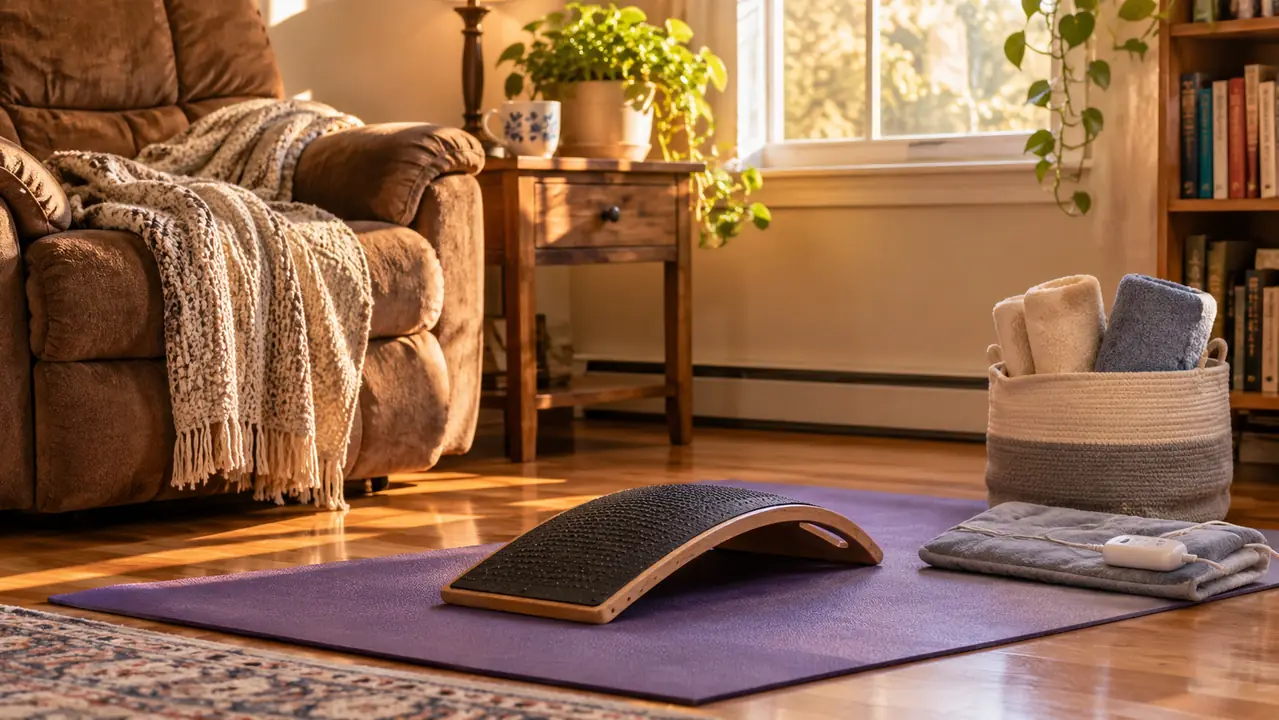
I bought the Magic Back Support back stretcher expecting very little. It is a curved board made of ABS plastic, it weighs a pound and a half, and it does not plug in, charge, or pair with anything. Twenty-six years of leaning over a dental chair have left my upper back and right shoulder tight in a way I had quietly accepted as normal, and I have bought enough recovery gadgets over the years to be a proper skeptic about the next one. So this is not a review written by somebody who unpacked a box yesterday and felt moved. It is what I actually found after a long stretch of using it in the evening, on a mat on the bedroom floor, in a chair at my desk, and once in the passenger seat of Glenn's car on the way back from the coast.
Here is the short version before the long one. The Magic Back Support device does one job well: it puts a fixed arch under your spine and lets your own body weight do the work, and for a stiff mid-back at the end of a hunching day that is a real thing to have in the house. What it does not do is fix anything. It is not a treatment, it is not a replacement for the physical therapy I should have asked about years ago, and the first week of using it is going to be uncomfortable in a way the product photos never suggest. The rest of this is the honest version, including the parts I did not enjoy.
The Quick Verdict
A simple, sturdy adjustable arch that genuinely helps a stiff mid-back, as long as you start at the lowest level and stop expecting it to treat anything.
Amazon Check Today's Price →Five minutes on the floor beats an hour of shifting around in your chair
A board, a curve, and your own body weight. No cord, no battery, nothing to charge and nothing to break. That is the whole proposition, and for a tight mid-back it is enough.
Amazon Check Today's Price on Amazon →How I've Used It
My routine is boring, which is the point. Most weeknights I unroll a mat on the bedroom floor around eight, lie back over the Magic Back Support board with my knees bent, and stay there for about five minutes while I listen to the ceiling fan and think about nothing in particular. Then I get up, walk a lap of the upstairs landing, and go back to whatever I was doing. The board lives in the canvas basket beside the recliner with a heating pad and a tennis ball, so getting it out takes two seconds and I have no excuse available. Glenn borrows it two or three times a week after golf, mostly for his hips, and he uses it flat on the carpet rather than on the mat because he says the mat slides under him. He is probably right.
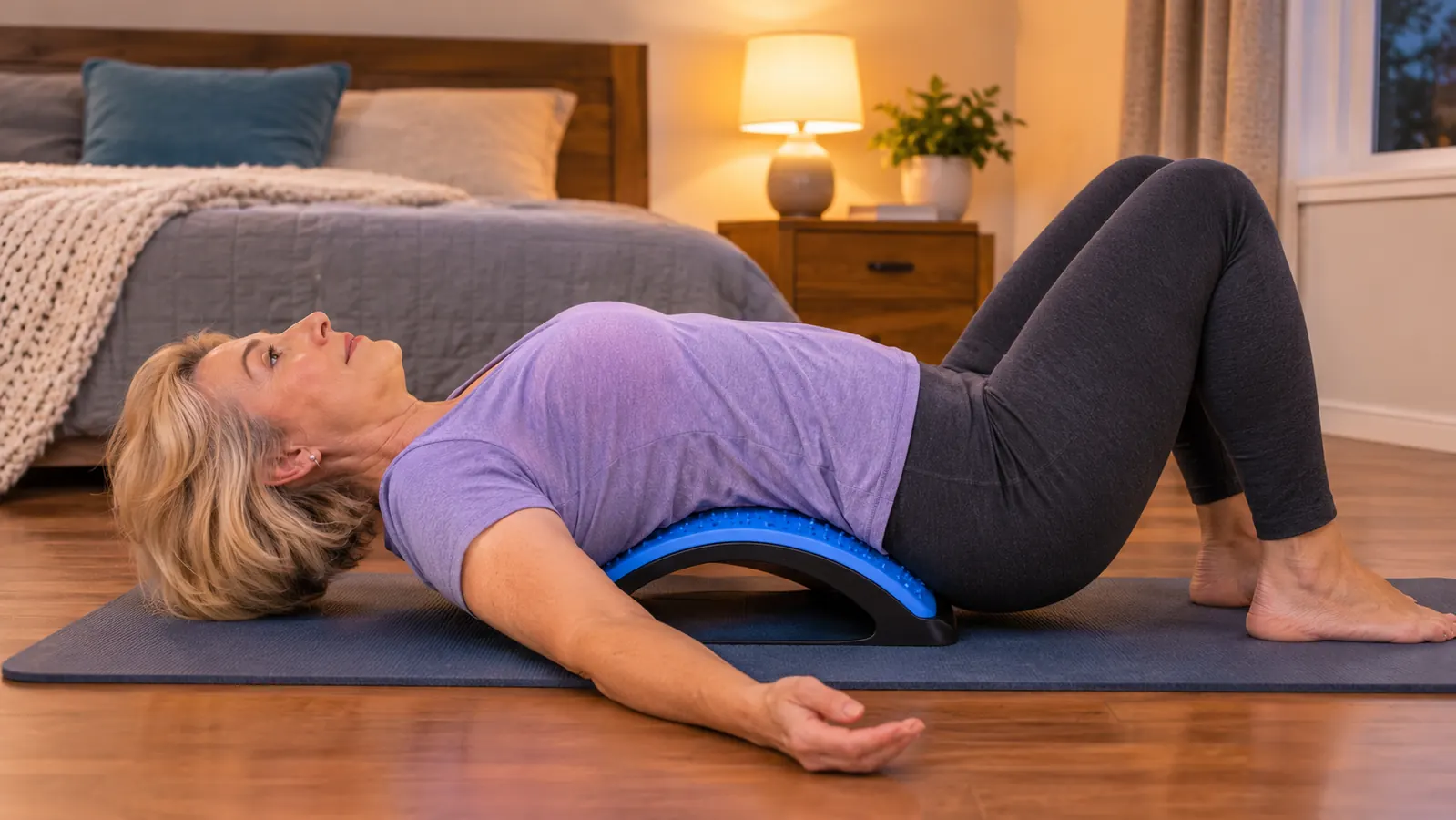
The thing I got wrong at the start was treating it like a stretch you hold until something gives. I set it up, lay back, and stayed for twenty minutes the first time because it felt like progress. It was not progress. I was sore in a dull, grippy way the next morning and I skipped it for four days out of irritation. Now I use it for five minutes, sometimes twice a day if I have been on my feet a lot, and I stop when my back has softened rather than when it hurts. I also stopped using it right before bed. It wakes me up rather than settling me down, and I would rather read for ten minutes than lie on the floor feeling wired.
What the Levels Actually Change
The board is height adjustable, and that is the only real adjustment it has. Setting it higher puts a deeper arch under your back, which means more stretch and more pressure on the spine. Setting it lower is gentler. I started at the lowest setting and stayed there for about three weeks before moving up, and I still do not use the highest setting for more than a minute or two at a time. If you are somebody who tends to push, this is a piece of equipment that will happily let you push and then send the bill two days later. There is no dial to turn and nothing to inflate. You set the level, you lie on it, you get up.
What surprised me is how much the exact position matters. If I put the arch too high, under my shoulder blades, it does almost nothing for the place that actually bothers me. If I put it lower, right where my ribcage starts to narrow, I get a stretch through the whole mid-back that I can still feel an hour later. Nobody tells you that you have to hunt for the spot. Expect to spend the first several sessions sliding the thing an inch up or down and paying close attention to what changes, because the difference between useful and pointless here is roughly two inches of placement.
The pressure comes entirely from your body weight, which is both the appeal and the limitation. On a soft surface like a bed your weight sinks in and the arch does less work. On a hard floor it does a lot. I use the mat on the floor because I want the firmer version, and I use it on the recliner only when my back is already reasonably loose and I just want a mild reminder of what straight feels like.
The board is height adjustable, and that is the only adjustment it has. You set the level, you lie on it, you get up, and your own body weight does the rest.
The Part Nobody Mentions: The First Two Weeks
The first two weeks were not pleasant, and I think that is worth saying plainly, because the reviews I read before buying all described immediate relief. My mid-back was so used to being curled forward that straightening it out felt like a mild argument. Not pain exactly. More like the sensation of a door that has not been opened in years. I was tight and slightly grumpy afterward, and I did not feel better in the moment. By the end of the second week that had settled, and the five minutes became something I looked forward to rather than something I got through.
The second thing nobody mentions is that it is not a whole-back device. My neck and right shoulder are the worst of it, and the board does nothing for those directly. What it does is make the mid-back loose enough that I can then turn my head without the whole area pulling. That is a knock-on benefit, not the product's job, and if you buy it expecting your neck to feel different you will be disappointed within a week.
Third, and this is the small one that annoyed me: it slides. Not badly, but on a bare floor it walks an inch or two while you are lying on it, and if you shift your weight it can scoot out of position. A mat fixes most of it. Glenn solved it by putting it straight on the carpet and never looking back. It is a trivial complaint right up until you are halfway through a stretch and have to sit up to straighten the thing again.
Where It Falls Short
Here is the honest list of what this thing is not. It does not massage. There is no motor and no power source, and the listing is clear on that point. Nothing on the board does anything to you that your own body is not already doing. If what you want is the kneading sensation of a massage gun or a heated shiatsu cushion, this is not that and it never claims to be. It is a shape you lie on.
It is also not comfortable in the way a padded product is comfortable. It is a board. Lying on a curved board for five minutes is a stretch, and stretching is not the same experience as relaxing. Some evenings I do not want to be stretched. I want to be warm and left alone, and on those evenings the heating pad wins and the board stays in the basket. That happens maybe twice a week and I have stopped feeling guilty about it.
It does not replace anything you should be doing either. I am a dental hygienist, not a physical therapist, and I say that deliberately. If your back pain is sharp, one-sided, running down a leg, or getting worse rather than better, an arch made of plastic is not the answer and no review on the internet should talk you out of seeing somebody qualified. What this board is good for is the ordinary, boring, everyday stiffness that comes from sitting and standing in the same shapes all day and never bending backward.
One more small thing. It is not a device you can use absent-mindedly. Five minutes on a board with nothing to look at and nothing to do is five minutes of lying there with your own thoughts. Some people will find that restful. I found it boring for the first week. I now use it as the five minutes immediately before I pick up a book, which solves the problem without changing the product at all.
What I Liked
- Sets a firm, adjustable arch under the mid-back with nothing to plug in or charge
- Light at a pound and a half, so it moves between the floor, a chair and the car without effort
- The height adjustment lets you start gentle and work up over weeks instead of days
- Sturdy ABS construction with no moving parts to wear out or break
Where It Falls Short
- A hard surface, so a session is a stretch rather than a comfort
- Nothing on it moves, which means it does no active work for you
- It can slide on a bare hard floor unless you put a mat under it
- Does nothing direct for the neck or shoulders, which is where a lot of desk tension lives
Chair, Car, and Floor: Three Different Jobs
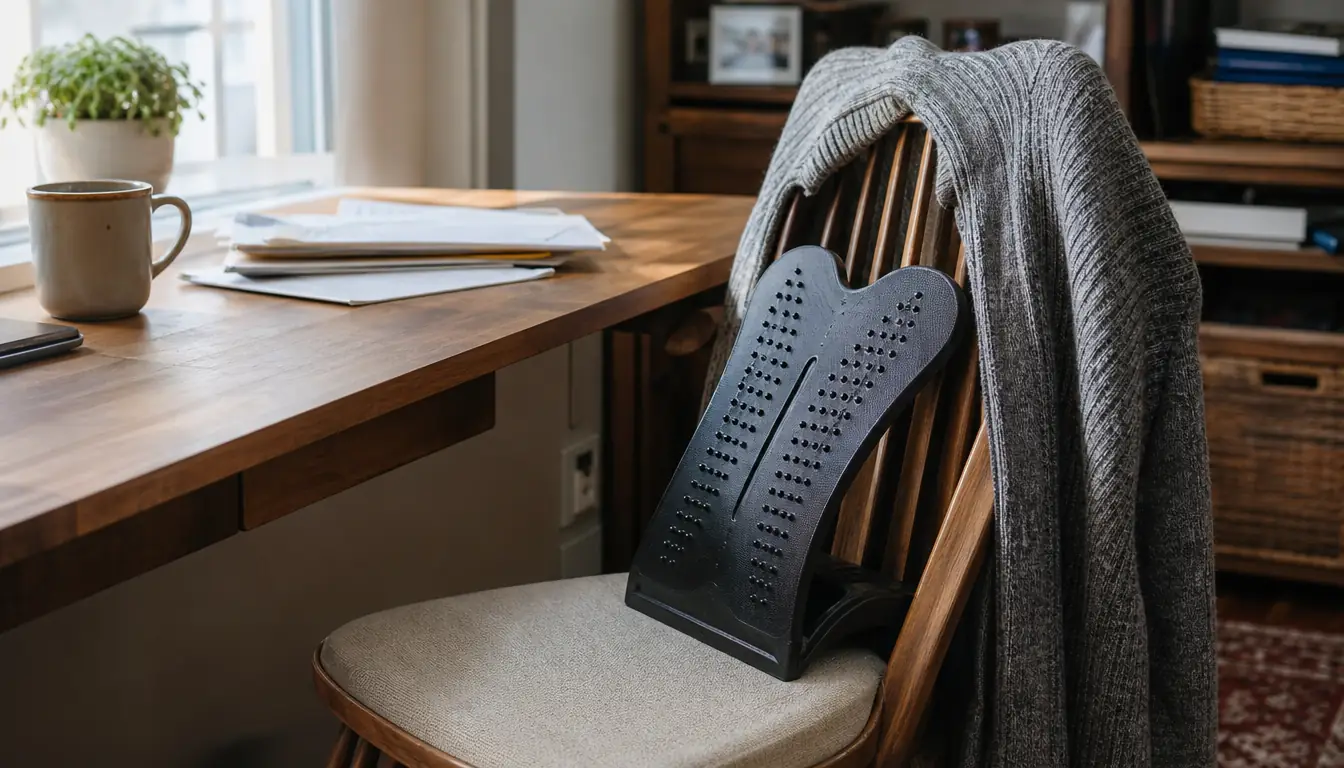
On the floor is where it works best, because you control exactly where the arch sits and how much weight you put on it. Lying flat with the knees bent is the position I use most. On a chair it is a different tool entirely. You set it against the lower back and lean into it while you sit, and you get a mild sustained pressure rather than a stretch. I use it that way at my desk during the day, propped so my lower back has something to lean into instead of the chair's flat cushion, and it takes about thirty seconds to arrange.
In the car it does the same job as the chair, only with worse posture to fight. Glenn uses it in the passenger seat on longer drives and says it takes about twenty minutes before he stops noticing his back, which is the point. Neither of those two uses is as effective as lying on the floor. They are maintenance, not correction. I would rather have them than not, and I would not want to rely on them alone.
The seat use is also where I think people get the most value for the least effort, because it requires nothing. You are already sitting. You put the board behind you and you lean. That is the entire practice. For somebody who knows they should be doing more for their back and is not going to, this is the version that actually happens on a Tuesday.
What I'd Tell a Friend Who Asked
If somebody at the office asked me about it, I would say this. It is a board with a curve in it, and the curve is the whole idea. Your spine spends all day in one shape and this puts it in the other shape for five minutes. That is not clever and it is not a treatment, but it is the thing I keep coming back to, because it is the only item in my recovery basket that asks nothing of me but lying down.
I would also tell them to put it where they will actually see it. Mine sits in the canvas basket next to the recliner, in the room where I sit every evening, not in a drawer upstairs. The first month I kept it in the bedroom and used it perhaps twice a week. Now that it is within arm's reach it gets used most nights, and the difference has nothing to do with the product and everything to do with whether reaching for it is a hassle.
Who This Is For
This is for the person with an ordinary, boring, tight mid-back. The one who sits at a desk or leans over a chair or drives a lot, who notices stiffness by the end of the day, and who wants something they can do at home for five minutes without a subscription, a routine to memorize, or a machine taking up floor space. It is for somebody who will genuinely unroll a mat. It is also, honestly, for somebody willing to start at the lowest level and be patient for two weeks, because the impatient version of using this product is the version that leaves you sore and put off it for good.
Who Should Skip It
Skip it if you have an undiagnosed back problem, a recent injury, or pain that moves down an arm or a leg. Skip it if you want something that actively works on you, because this does not. Skip it if you know in your heart that a tool you have to get down on the floor to use is a tool that will live in a closet by the end of the month. And skip it if you have already tried a foam roller and found you cannot tolerate pressure along your spine, because this is pressure along your spine in a more directed form. The Magic Back Support board is a good, plain answer to a small daily problem. It is not an answer to a large one, and it does not pretend to be.
If your mid-back is the problem, start at the lowest level and give it two weeks
An adjustable arch, no cord, no battery, and nothing to do but lie back for five minutes and breathe. It will not treat anything. It will make the end of a long day noticeably less stiff.
Amazon Check Today's Price on Amazon →